

Latest posts
How to Spot Authentic Luxury Perfume and Beauty Products

Luxury beauty and fragrance have never attracted more consumer interest — or more counterfeit activity. As the global market for premium perfumes and high-end skincare continues to expand, so does the parallel economy of imitation products designed to look, and in some cases smell, remarkably close to the real thing. The difference between an authentic luxury perfume and a sophisticated fake is not always immediately visible to the untrained eye — and that gap is precisely what counterfeit producers exploit.
The case for verifying authentic skincare products and fragrances before purchasing is not simply about money, though the financial stakes are real. It is about the formulation integrity that luxury brands invest significantly in maintaining — the research-backed active ingredients, the quality-controlled manufacturing processes, the fragrance compositions that reflect years of development. When a counterfeit enters the equation, none of that investment is present. What you receive may look similar; what it contains, and how it performs, is an entirely different matter.
This guide provides the practical knowledge to close that gap — covering everything from packaging authentication to batch code verification, from the warning signs of counterfeit fragrances to the purchasing channels that offer genuine protection. By the end, you’ll approach every luxury beauty purchase with the kind of informed confidence that comes from understanding exactly what authentic looks like.
Table of Contents
Why Authenticity Matters in Luxury Beauty?
The word “authentic” carries real weight in the context of luxury beauty — not as a marketing abstraction, but as a description of a specific set of properties that genuine products possess and counterfeit ones do not.
Quality and Formulation Integrity
Authentic luxury beauty products are the result of significant investment in ingredient quality, formulation research, and manufacturing standards. A genuine Chanel No. 5 contains raw materials sourced to specific quality parameters — Grasse rose absolute, May jasmine from controlled cultivation — at concentrations and in combinations that have been refined across decades. A counterfeit bearing the same name may use synthetic approximations at inconsistent concentrations, formulated without the stability controls, pH calibration, or compatibility testing that the original undergoes before reaching a consumer.
The formulation integrity of genuine luxury beauty products is what produces the experience they’re known for: the way a serum absorbs, the way a fragrance develops over hours rather than fading within minutes, the consistency of result that justifies continued purchase. Counterfeits cannot replicate this, because replicating it requires the same investment that produces it.
Brand Craftsmanship and Research Investment
Major luxury beauty and fragrance houses invest substantially in research and development — proprietary delivery systems, novel ingredient combinations, clinical testing protocols, and manufacturing technologies that produce genuinely differentiated products. When you purchase an authentic luxury perfume from a house like Hermès, Guerlain, or Tom Ford, part of what you’re paying for is the cumulative investment in that product’s development. Counterfeit products contribute nothing to this process and benefit from it illegitimately.
The craftsmanship visible in genuine luxury products — the weight and finishing of a bottle, the precision of printed packaging, the accuracy of label typography — is the external expression of that internal investment. It is also, as this guide will explain, one of the most reliable tools for authentication.
Consumer Confidence and Product Performance
Purchasing luxury beauty products represents a considered investment — one that consumers make based on the expectation of consistent, high-quality performance. Authentic skincare products from established luxury brands deliver that consistency because they are manufactured to the same standards across every batch. The serum you purchase today should perform identically to the one you purchased a year ago, because both were produced under the same controlled conditions with the same quality-verified ingredients.
Counterfeit products offer none of this assurance. Their performance is unpredictable by definition — because their formulation is uncontrolled, their ingredients unverified, and their manufacturing conditions unknown. Consumer confidence built on genuine products is one of the most valuable things luxury beauty brands protect; it is also, from a purchasing perspective, one of the clearest reasons to protect yourself.
The Growing Problem of Counterfeit Beauty Products
The global counterfeit beauty market has expanded significantly alongside the growth of e-commerce — the same platforms that make luxury beauty more accessible have also made counterfeit distribution considerably easier to operate and harder to detect. Understanding where and how counterfeits enter the market helps consumers identify the points of vulnerability in their own purchasing habits.
Fake Fragrances
Counterfeit beauty products are most commonly encountered in the fragrance category. Perfume counterfeiting is particularly prevalent because fragrance composition is difficult to verify without chemical analysis, the bottles and packaging of major brands are extensively photographed and referenced online, and consumer expectation of scent varies enough by individual that a fake that smells “close enough” may not immediately trigger suspicion. Fake fragrances often use lower-cost synthetic aromatic compounds to approximate the scent profile of the original — the result may be initially recognizable but typically fades faster, develops differently on skin, and lacks the complexity of the genuine article’s heart and base notes.
Counterfeit Skincare Products
Counterfeit skincare products present a different challenge. While fake fragrances are primarily a financial and quality issue, counterfeit skincare products may contain ingredients that differ meaningfully from the genuine formulation — at minimum producing a product that underperforms; at worst, one that contains unverified substances not present in the original. Luxury skincare counterfeits tend to be most common in the highest-profile product categories: eye creams, vitamin C serums, and hero moisturizers from brands with significant global recognition. These products attract counterfeit production precisely because their reputation makes them easy to sell.
Unauthorized Distribution Channels
A significant proportion of counterfeit luxury products reach consumers through unauthorized distribution channels — third-party marketplace sellers, social media commerce, grey market importers, and online discount retailers presenting themselves as legitimate. The luxury beauty industry has made substantial efforts to control authorized distribution precisely because unauthorized channels cannot be held to the quality and authenticity standards that authorized retailers maintain contractually. Understanding this distinction is the most important single piece of practical knowledge in luxury beauty authentication.
Fake vs Real Designer Fragrance — Key Differences to Look For
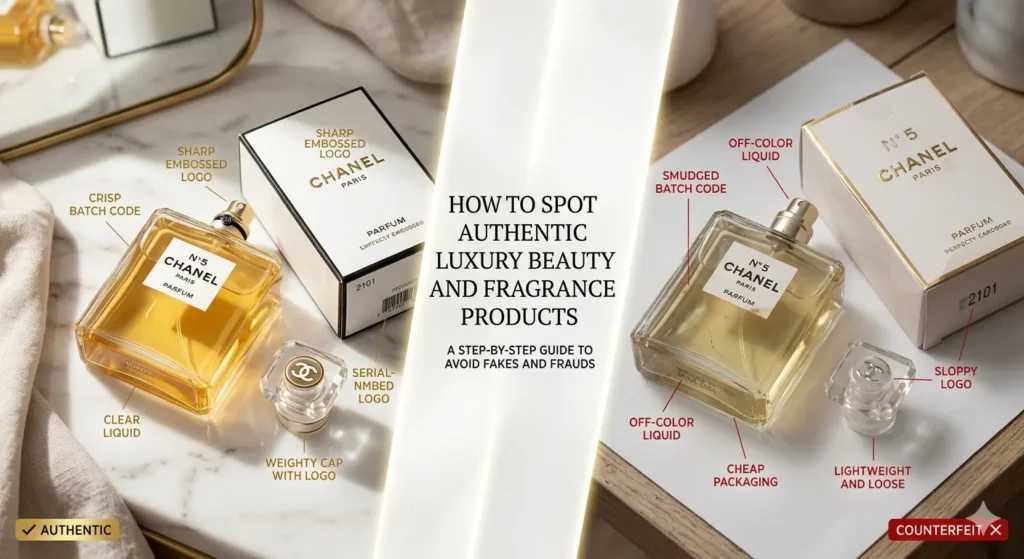
A careful examination of packaging, bottle quality, and product details reveals most fake vs real designer fragrance differences to an informed eye. These are the specific areas worth examining before any purchase decision.
Packaging Quality and Print Precision
Genuine luxury fragrance packaging is produced to exacting print specifications: precise color matching, sharp typography, consistent alignment, and materials that maintain their quality through the supply chain. Counterfeit beauty products typically exhibit visible printing imperfections — slightly blurred text, inconsistent spacing between characters, color that doesn’t match official imagery, or cardboard that feels lighter or less rigid than the genuine article. Hold the box under good light and examine it against official product photographs from the brand’s own website. Even minor discrepancies in font weight, color saturation, or text alignment are worth investigating further.
Bottle Craftsmanship and Finishing Details
The bottles used by luxury fragrance houses are manufactured to precise specifications — glass weight, mold precision, surface clarity, and finishing quality are all controlled and consistent. A genuine Dior Sauvage bottle has a specific weight, a precisely machined cap, and glass clarity that is difficult and expensive to replicate accurately. Counterfeit bottles are commonly lighter, slightly less precisely formed, with caps that fit less precisely, surface imperfections in the glass, or spray mechanisms that dispense product inconsistently. Run your hand along the bottle’s surface — genuine luxury glass has a uniformity and clarity that is perceptible to touch as much as sight.
Batch Codes and Serial Numbers
Every genuine luxury beauty and fragrance product carries a batch code — a sequence of letters and numbers that identifies the manufacturing batch, production date, and in many cases the specific production facility. This code appears on both the bottle and the box, and on genuine products, both codes match. Authentic luxury perfume verification through batch codes can be cross-referenced using third-party tools such as CheckFresh or CheckCosmetic, which maintain databases of legitimate batch code formats for hundreds of luxury brands. Missing batch codes, mismatched codes between bottle and box, or codes in formats inconsistent with the brand’s conventions are reliable indicators of a non-genuine product.
Label Accuracy and Typography
Label accuracy is one of the most reliable authentication tools available to consumers. Luxury brands use specific typefaces, point sizes, and spacing conventions that are consistent across all genuine products and which counterfeit producers routinely fail to replicate exactly. Examine the fragrance concentration label (Eau de Parfum, Eau de Toilette), the country of manufacture, and the ingredient listing — all should match the brand’s official labeling exactly. Misspellings, incorrect concentration descriptions, wrong country of origin, or missing EU/US regulatory information are each individually significant and collectively decisive.
Fragrance Consistency and Scent Evolution
The most revealing test of fake vs real designer fragrance is the fragrance itself — specifically how it evolves over time. Genuine luxury fragrances are composed in three structured phases: top notes (the initial burst, lasting 10–30 minutes), heart notes (the core character, lasting several hours), and base notes (the dry-down that persists for hours after application). Counterfeit fragrances typically replicate the top note profile with some accuracy — it’s the cheapest part to approximate — but fail to deliver the heart and base note development that defines the authentic composition. A fragrance that smells recognizable for the first twenty minutes and then fades to a flat or chemical note is a reliable indicator of a non-genuine product. Explore our full luxury fragrance collections to familiarize yourself with how genuine compositions evolve.
How to Verify an Authentic Luxury Perfume?
A structured verification process applied before any luxury fragrance purchase — whether in-store at an unfamiliar retailer or online — provides reliable protection against counterfeit products. This step-by-step approach covers the most important authentication touchpoints.
Examine Packaging Carefully
Remove the product from any outer shipping packaging and examine the retail box in good natural or white light. Check print sharpness, color accuracy, and cardboard weight against official brand imagery. Examine all six sides of the box — counterfeit producers often focus effort on the front panel and neglect side and base panel accuracy. Verify that all text matches official labeling exactly, including punctuation, capitalization, and spacing. Check that the cellophane wrap (where applicable) is applied evenly and sealed consistently — genuine products use consistent heat-sealing; counterfeits often show irregular or poorly aligned sealing.
Verify Manufacturer Information
Every authentic luxury perfume sold in the EU or US carries manufacturer information required by regional cosmetic regulations: the manufacturer or responsible party’s name and address, a list of ingredients (INCI nomenclature for EU products), and the country of manufacture. This information should be present, complete, and accurate. Cross-reference it against the brand’s official website or the authorized retailer’s product listing. Regulatory information that is absent, incomplete, or inconsistent with official sources is a significant authentication concern.
Check Batch and Production Codes
Locate the batch code on both the bottle and the external box — typically embossed, printed, or stamped on the base of each. Confirm that both codes match. Enter the batch code into a free verification tool (CheckFresh.com and CheckCosmetic.net both maintain extensive databases) to verify that the code format is consistent with the brand’s genuine production codes. Note that these tools identify code format legitimacy rather than providing absolute product authentication — they are one layer of verification rather than the complete process.
Purchase Only from Authorized Sellers
The single most effective protection against counterfeit luxury beauty products is purchasing exclusively through authorized retail channels. Authorized retailers maintain contractual obligations to brands regarding product sourcing, storage conditions, and authenticity standards that unauthorized channels do not. A list of authorized retailers for any major luxury fragrance or skincare brand is available on that brand’s official website — this list should be consulted before making any unfamiliar purchase. Visit our designer perfume guides for brand-specific purchasing guidance.
Compare with Official Product Imagery
Before purchasing any luxury beauty product from an unfamiliar source, spend five minutes comparing the product in question against official imagery from the brand’s own website. Examine the bottle shape, cap design, label placement, packaging color, and any decorative elements. Luxury brands control their product imagery precisely — the official photography is the most accurate reference available. Discrepancies visible in a side-by-side comparison, however minor, deserve investigation rather than rationalization.
How to Identify Authentic Skincare Products?
Authentic skincare products carry their own set of authentication markers — and the verification process, while similar in principle to fragrance authentication, has category-specific touchpoints worth examining separately.
Packaging Consistency and Seals
Genuine luxury skincare products are packaged with the same precision and consistency as their fragrance counterparts. Examine the packaging for print quality, color accuracy, and material weight. Many authentic luxury skincare products also include tamper-evident seals — a sealed pump mechanism, a foil seal beneath a jar lid, or a plastic safety ring around a tube cap. The presence of these seals in good condition is reassuring; their absence on a product that typically includes them is worth investigating. Packaging that shows signs of having been opened and resealed is a clear concern.
Ingredient List Verification
Authentic luxury skincare products carry complete ingredient lists in INCI (International Nomenclature of Cosmetic Ingredients) format, required by cosmetic regulations in both the EU and US. Cross-reference the ingredient list on the product you’re evaluating against the ingredient list published on the brand’s official website. Counterfeit skincare products often carry incomplete, inaccurate, or generic ingredient lists that don’t match the genuine formulation. A mismatch at any point — a missing ingredient, an incorrect order, a non-INCI name used where INCI nomenclature should appear — is a reliable authentication signal. Explore our luxury skincare collections for products verified through authorized retail channels.
Product Texture and Formulation Consistency
If you have prior experience with a genuine luxury skincare product, its texture, absorption speed, and scent (where applicable) should be consistent across genuine batches within a reasonable range. A moisturizer that was notably richer or thinner than you remember, a serum that absorbed differently or left a different residue, or a fragrance profile that felt meaningfully different are all worth noting. Formulation consistency is one of the quality standards that luxury brands invest most heavily in maintaining — and its absence in a product claiming to be genuine is a meaningful signal.
Official Retailer Validation
As with fragrance, the most reliable authentication for luxury skincare is purchase channel. Authentic skincare products purchased from a brand’s own website, an authorized department store, or a verified luxury beauty retailer carry the retailer’s implicit guarantee of authenticity through their supply chain obligations. Our beauty and wellness categories link to authorized retail channels for all major luxury skincare brands represented on this platform.
Warning Signs That a Product May Be Counterfeit
Certain indicators, present individually or in combination, should prompt careful verification before any luxury beauty purchase proceeds.
Unusually low pricing is the most commonly cited warning sign — and for good reason. Luxury beauty products have established retail price points maintained consistently across authorized channels. A fragrance or skincare product offered at 40–60% below its standard retail price outside of a legitimate sale event is almost certainly not a genuine product. Authentic luxury products hold their pricing; counterfeits exploit price as the primary sales mechanism.
Poor packaging quality — visible printing imperfections, lightweight cardboard, imprecise typography, or surface finishes that don’t match official imagery — is frequently the most immediately detectable sign of a counterfeit, particularly when the product is examined in person rather than assessed from a photograph.
Missing batch codes — absent from either the bottle or the box, or present on one but not the other — indicate a product that has bypassed legitimate manufacturing and quality control processes. All genuine luxury beauty products carry batch codes; their absence is unambiguous.
Suspicious online sellers — third-party marketplace accounts with limited trading history, no verifiable physical address, unusually broad inventory of high-demand luxury products, or customer reviews that focus heavily on delivery speed rather than product quality — represent an elevated authenticity risk that warrants the additional verification steps outlined in this guide.
Inconsistent branding elements — a logo that differs subtly from the official version, a color that doesn’t match official brand colors across all touchpoints, or typography that is close but not exactly correct — indicate a product produced outside the brand’s official supply chain.
Product quality variations — inconsistent product fill levels, formula texture or color that differs from the expected profile, or packaging that varies meaningfully from one unit of the same product to another — suggest manufacturing conditions that don’t meet the consistency standards of genuine luxury production.
Where to Buy Genuine Luxury Beauty and Fragrance Products
The purchasing channel is the single most important factor in luxury beauty authentication. Where you buy is as important as what you verify.
Authorized Retailers
Authorized retailers are businesses that have a formal contractual relationship with luxury beauty brands — one that includes obligations regarding product sourcing, storage, and authenticity. Department stores with established luxury beauty counters (Harrods, Harvey Nichols, Selfridges, Nordstrom, Saks Fifth Avenue), authorized perfumery chains, and certified luxury beauty specialists all fall into this category. Their authorization status is typically verifiable through the brand’s official website retailer finder.
Official Brand Websites
The brand’s own e-commerce platform is the most direct route to guaranteed product authenticity. Every product purchased through an official brand website comes from the brand’s own verified stock — there is no third-party supply chain to introduce authenticity risk. Most major luxury beauty brands now operate direct e-commerce globally, making this option accessible for the majority of consumers regardless of location.
Trusted Luxury Beauty Stores
Specialist luxury beauty retailers — physical or online — that have built their business model around authorized sourcing and product authenticity offer a reliable middle ground between brand-direct purchasing and the wider retail market. Look for retailers that publish their authorized retailer credentials, maintain transparent returns and authentication policies, and operate verifiable physical presences. Our beauty product buying guides include guidance on identifying and evaluating authorized luxury beauty retailers.
Verified Ecommerce Platforms
Major e-commerce platforms have implemented varying degrees of seller verification and product authenticity programs — with meaningful variation in the level of protection they actually provide. Purchasing luxury beauty through a marketplace’s directly fulfilled inventory (fulfilled by the platform itself rather than a third-party seller) typically offers stronger authenticity assurance than third-party marketplace listings, where seller verification is less consistently applied. When purchasing through any e-commerce platform, verify seller authorization status and review the platform’s authenticity guarantee policies before completing a purchase.
Common Authentication Myths
Several widely held beliefs about luxury beauty authenticity can lead consumers to make poorly informed purchasing decisions. Each of these deserves direct examination.
A high price guarantees authenticity. It does not. Sophisticated counterfeit products are sometimes priced at or near the genuine retail price specifically to avoid triggering price-related suspicion. The pricing of a luxury product is one input in authentication, not a definitive one. A product priced correctly can still be a counterfeit — which is why verification of physical product characteristics and purchasing channel remain essential regardless of price.
Counterfeits are always obvious. The most commonly encountered counterfeits are not always obvious — particularly to consumers who have never seen the genuine product in person. High-quality counterfeit fragrance packaging can be genuinely impressive at first glance. The verification process outlined in this guide addresses this specifically: systematic examination across multiple touchpoints reveals discrepancies that a first impression may not.
Luxury packaging alone proves authenticity. Packaging is one authentication layer among several, not a conclusive one. Counterfeit producers invest specifically in packaging quality because it is the consumer’s first point of reference. Beautiful packaging should prompt careful verification of the remaining authentication touchpoints — it should not short-circuit the process.
All marketplace sellers are equally reliable. They are not. Marketplace seller verification varies enormously across platforms and individual accounts. A seller’s star rating or review count is not a reliable proxy for authenticity — review profiles can be accumulated across a range of product categories and don’t necessarily reflect specific luxury beauty purchasing experience. Authorization status, verifiable brand relationships, and transparent sourcing information are the meaningful variables.
Expert Tips for Buying Luxury Beauty Products Online
Online purchasing of luxury beauty products introduces specific authentication challenges that in-person shopping does not — you cannot examine physical packaging before purchase, scent cannot be evaluated, and the gap between product imagery and the product you receive may only be apparent on arrival. These practices reduce that risk meaningfully.
Research the seller before completing any purchase. Verify their authorized retailer status through the brand’s official website if possible. Examine their trading history, the range of products they stock, and whether their business has a verifiable physical presence. A seller whose inventory consists exclusively of high-demand luxury items at meaningfully reduced prices, with no verifiable brand authorization, warrants caution regardless of positive reviews.
Review return policies carefully. Authorized luxury retailers operate clear, verifiable return and exchange policies. A seller who is unable or unwilling to accept returns, or whose return policy is difficult to locate and interpret, is not operating to the standard of a legitimate authorized retailer. The ability to return a product if its authenticity is in question is a fundamental protection.
Verify product imagery against official brand sources before purchasing. Request additional photographs from the seller if the listing imagery is insufficient to examine packaging detail. Most legitimate retailers are willing to provide additional product images on request — reluctance to do so is itself informative.
Check customer reviews responsibly. Look specifically for reviews from customers who have purchased the same luxury beauty product and who comment on product quality and authenticity rather than only delivery experience. Reviews that focus exclusively on packaging speed or shipping quality provide limited authentication signal. Reviews that describe the scent, texture, or formulation experience of the product itself — particularly from reviewers with verified purchase histories in luxury beauty — are more informative.
Confirm retailer authorization when available. Many luxury beauty brands publish authorized retailer lists on their official websites. Consulting this list before purchasing from an unfamiliar platform or retailer takes minutes and provides meaningful assurance. Visit our brand-specific fragrance collections and luxury skincare collections for products sold exclusively through verified authorized retail channels.
Frequently Asked Questions About Authentic Luxury Beauty Products
How can I tell if a luxury perfume is authentic?
Verify an authentic luxury perfume through a systematic process: examine packaging print quality and material weight against official brand imagery; check that batch codes on both bottle and box match and conform to the brand’s code format (using tools like CheckFresh.com); verify label accuracy including concentration, country of manufacture, and ingredient listing; confirm purchase channel authorization through the brand’s official website; and evaluate the fragrance’s development through top, heart, and base note phases — genuine luxury fragrances evolve over hours rather than fading quickly to a flat note.
What are the biggest differences between fake and real designer fragrances?
The most reliable differences between fake vs real designer fragrances are visible in packaging print precision (typography accuracy, color matching, cardboard weight), bottle craftsmanship (glass weight, cap fit, surface clarity), batch code presence and validity, label accuracy against official specifications, and fragrance evolution — genuine compositions develop through three structured phases, while counterfeits typically approximate the top note and fail to deliver the heart and base note character that defines the authentic scent profile.
How can I verify authentic skincare products online?
To verify authentic skincare products online: cross-reference the product’s ingredient list against the official formulation published on the brand’s website; examine all available product imagery against official brand photography for packaging accuracy; confirm the seller’s authorized retailer status through the brand’s official retailer finder; review the seller’s returns policy and trading history; and where possible, purchase through the brand’s own e-commerce platform or a verified authorized retailer to eliminate supply chain authenticity risk entirely.
Is buying from authorized retailers important?
Purchasing from authorized retailers is the single most effective protection against counterfeit luxury beauty and fragrance products. Authorized retailers maintain contractual obligations to luxury brands regarding product sourcing, storage conditions, and authenticity standards. These obligations — and the ongoing commercial relationship that depends on maintaining them — provide protections that unauthorized sellers cannot offer. Verifying authorization status through a brand’s official website before purchasing from any unfamiliar retailer takes minutes and provides substantial assurance.
What should I do if I suspect a beauty product is counterfeit?
If you suspect a luxury beauty product may be counterfeit: stop using it and set it aside for reference; contact the retailer directly and request documentation of their product sourcing and authorization status; contact the brand’s official customer service — most major luxury houses have dedicated authentication support and can advise on next steps; if purchased through a marketplace, report the seller to the platform using their counterfeit reporting process; and if appropriate, report to consumer protection authorities in your region. Most authorized retailers will process returns on products with legitimate authenticity concerns.
Buy with Knowledge, Not Just with Trust
The knowledge to identify an authentic luxury perfume or verify authentic skincare products is not difficult to develop — it is a matter of knowing where to look, what to look for, and which purchasing channels provide the assurance that individual product verification alone cannot always guarantee.
The most reliable protection remains the purchasing channel itself. Authorized retailers, official brand websites, and verified luxury beauty specialists represent the standard of sourcing integrity that makes individual product verification largely a secondary layer rather than a primary one. When the channel is trusted, the product it delivers almost invariably is too.
Beyond that, the practices outlined in this guide — batch code verification, packaging examination, label accuracy cross-referencing, and an understanding of how genuine fragrance evolves versus how counterfeits perform — equip you to approach any luxury beauty purchase with the kind of informed eye that counterfeit products are not designed to withstand.
Explore our luxury fragrance collections and designer perfume guides for products sourced through fully authorized channels. Browse our luxury skincare collections and beauty product buying guides for additional authentication guidance by category. Every product available through this platform is sourced from verified authorized supply chains — because your confidence in what you’re purchasing is the foundation of everything we do.

 Brush
Brush Makeup Mirrors
 Body Lotions & Body Oils
 Personal Scales
 Perfume Coffrets
 Perfume Testers
 All Eyewear
 Unisex
 Optical
 Contact Lenses
 Home Fixtures
 Dining & Bar