


Latest posts
The Difference Between Regular and Luxury Skincare Products

The skincare market has never offered more choice — or more confusion. A single ingredient like hyaluronic acid now appears in products priced anywhere from £8 to £280, and the consumer standing at a beauty counter or scrolling through an online skincare category is increasingly left to determine, without much guidance, whether the price difference reflects a real difference in the product. Sometimes it does. Sometimes it reflects packaging, marketing, and brand heritage as much as formulation. And sometimes — particularly in the space between luxury skincare and medical-grade skincare — the distinctions are more nuanced than either category’s advocates tend to admit.
Understanding the real luxury skincare benefits and where they exist — and where they are overstated — is one of the most useful things a skincare consumer can develop. This premium skincare comparison is built around that goal: an honest, evidence-conscious analysis of what separates luxury formulations from regular retail skincare, how professional-grade products fit into that picture, and how to make skincare investments that genuinely serve your skin rather than simply your instincts about quality.
This is not an argument for or against any price point. It’s a framework for understanding what you’re actually buying.
Table of Contents
What Defines Luxury Skincare?
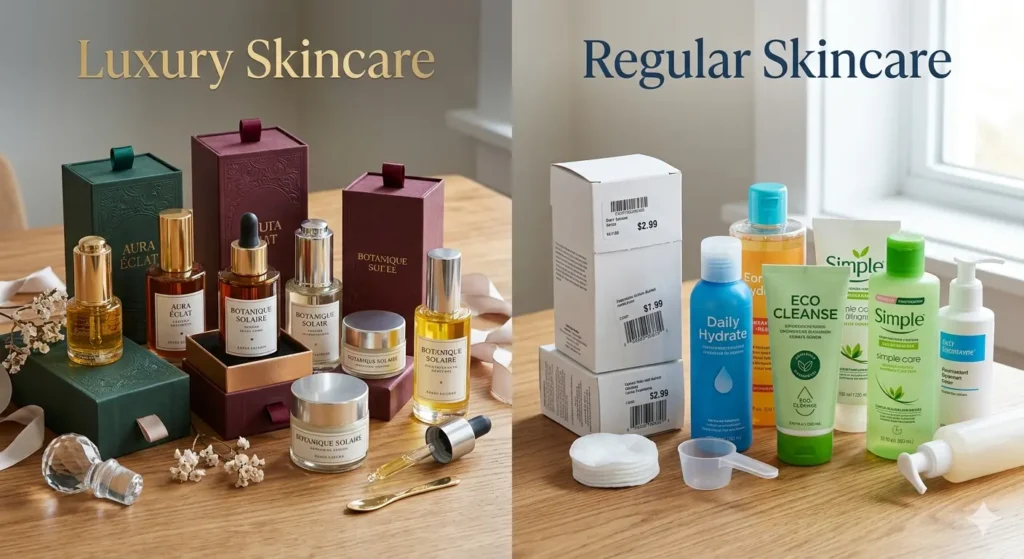
Luxury skincare is not a regulatory category — no governing body distinguishes a luxury formulation from a standard one. In practice, the distinction is defined by a convergence of choices a brand makes across several dimensions: ingredient sourcing, formulation technology, sensory design, packaging, research investment, and the overall experience of using the product. A brand like La Mer, Augustinus Bader, or Sisley may invest more significantly in one or several of these areas than a mass-market counterpart — and the resulting product reflects those choices in ways that range from immediately perceptible to cumulative.
Premium Ingredients and Sourcing Standards
The most frequently cited differentiator in luxury beauty products is ingredient quality — and while this can be overstated, it has a genuine basis. Some premium brands source ingredients from specific, controlled origins where quality parameters are tighter than commodity alternatives: Bulgarian rose absolute rather than synthetic rose; Grasse jasmine grown to exacting standards; bakuchiol extracted from specific botanical cultivars. These sourcing decisions add cost, and they can add perceptible quality — but the relationship between ingredient origin and finished product performance is not always linear, and it is not guaranteed by price alone.
What is more consistently differentiating is ingredient concentration. Luxury formulations often deliver active ingredients — vitamin C, retinoids, peptides, hyaluronic acid — at higher concentrations than mass-market alternatives, which may use the same ingredient at a level sufficient to appear on the label but insufficient to produce a meaningful clinical effect. This distinction is worth investigating when choosing between price points.
Advanced Formulation Technologies
Beyond individual ingredients, formulation technology is where many serious luxury brands genuinely distinguish themselves from mass-market alternatives. Encapsulation technology, for example, protects unstable actives like retinol or vitamin C from oxidation, ensuring they remain potent through the product’s shelf life and deliver more effectively to the skin. Liposomal delivery systems allow certain ingredients to penetrate the skin barrier at depths that standard formulations cannot reach. Micro-emulsion technologies create textures that feel luxurious while enabling faster, more uniform absorption.
These are not marketing abstractions. They represent real investment in research and development — typically the kind that requires partnerships with dermatological research institutions, proprietary manufacturing processes, and multi-year testing cycles. Brands like Augustinus Bader (whose formulation is built around a patented TFC8® complex developed from decades of academic wound-healing research) and Estée Lauder Advanced Night Repair (backed by over 40 years of progressive formulation development) demonstrate what genuine R&D investment looks like at the luxury tier.
Elevated Sensory Experiences and Product Design
The third pillar of luxury skincare is experiential: how the product feels, smells, applies, and absorbs. A well-formulated luxury serum has a texture that communicates quality before it demonstrates it — the weight of it, the way it moves, the speed at which it absorbs without residue, the subtle fragrance (if present) that doesn’t irritate. This is not superficial. Sensory quality influences compliance — and skincare only works when used consistently. A product that feels genuinely pleasurable to apply is one that gets used every morning and evening, without exception, for months. That compliance is a real factor in outcomes.
Packaging, too, is more than aesthetic. Airless pump dispensers, UV-protective glass, and vacuum-sealed mechanisms protect formulations from oxidation and contamination in ways that simpler packaging cannot. These systems add cost, and they add genuine functional value — particularly for formulations containing active ingredients that degrade on contact with air or light. Visit our luxury skincare collections to see how premium design and formulation intersect in practice.
What Defines Regular Skincare Products?
Regular skincare — the products available at pharmacies, supermarkets, and mass-market beauty retailers — encompasses an enormous and frequently underestimated range. Some of the most clinically validated skincare products in existence are not luxury products: La Roche-Posay, CeraVe, and Paula’s Choice are all mass-market or mid-market brands that have produced formulations backed by rigorous dermatological research and genuine clinical evidence.
Accessibility and Mass-Market Appeal
The defining characteristic of regular skincare is accessibility — in price, availability, and formulation simplicity. These products are designed to work for the widest possible consumer base, across a range of skin types and concerns, without requiring specialist knowledge to use correctly. This is a genuine strength, not a limitation. The barrier to entry is low, the risk of irritation from overly complex formulations is reduced, and the products are consistently available without waiting lists or specialist distribution.
Essential Skincare Functionality
Many mass-market and mid-range products perform core skincare functions — cleansing, moisturizing, basic UV protection, and barrier support — very effectively. The fundamental needs of healthy skin are not complicated, and the ingredients that address them are not exclusive to luxury formulations. A glycerin-rich moisturizer from a pharmacy brand and a glycerin-rich moisturizer from a luxury house may perform similarly on the basic metric of skin hydration.
Simplified Formulations and Broader Distribution
Regular skincare products typically use a smaller number of active ingredients, at concentrations calibrated for broad tolerability rather than maximum efficacy. Formulations are often stabilized for longer shelf life and wider distribution conditions — which sometimes means lower concentrations of potent but unstable actives. This simplification serves the mass market well and is not inherently a compromise, but it does mean that products targeting specific, advanced concerns — photoaging, structural collagen support, deep hydration — may deliver differently than luxury alternatives built around concentrated, stabilized active systems.
Premium Skincare Comparison — Key Differences That Matter
A direct premium skincare comparison across five dimensions helps clarify where the distinctions are real and where they are primarily marketing.
Ingredient Quality and Concentration
The most meaningful differences between luxury and regular skincare products tend to sit here. Luxury brands are more likely to use higher concentrations of active ingredients, more stable ingredient forms (such as ascorbyl glucoside or ethyl ascorbic acid rather than less stable forms of vitamin C), and botanical extracts from controlled, high-quality sources. These differences are most significant for consumers targeting specific concerns — brightening, firming, anti-aging — where ingredient efficacy at meaningful concentrations matters considerably.
Research and Development Investment
High-end skincare brands at the luxury tier tend to invest more heavily in proprietary research — both in the development of novel delivery systems and in the clinical testing of finished formulations. This investment is reflected in product performance but also in the body of evidence available to support specific claims. La Mer’s Miracle Broth, Augustinus Bader’s TFC8® complex, and Estée Lauder’s Bifidus Amplifier technology are all backed by published or peer-reviewed research that goes beyond the standard ingredient dossiers available to any brand formulating with widely available actives.
Formulation Sophistication
Formulation sophistication encompasses delivery systems, pH optimization, ingredient compatibility, and stability management across the product’s full shelf life. Advanced skincare technology in luxury formulations often involves encapsulation, time-release systems, or multi-phase emulsions that simply aren’t economically viable at mass-market price points. These systems can meaningfully influence how well an active ingredient performs in a finished product — not just at first application, but across the months of consistent use that determine real outcomes.
Product Texture and Application Experience
Texture is a legitimate differentiator. The feel of a luxury serum — its viscosity, absorption speed, residue profile, and how it interacts with subsequent products in a routine — is engineered as carefully as its active ingredient profile. This is not vanity; it is compliance engineering. Products that feel good to use get used. And skincare outcomes are almost entirely determined by consistent, long-term application rather than single applications of superior products.
Packaging and Preservation Systems
Functional packaging — particularly for formulations containing vitamin C, retinol, or other oxidation-sensitive actives — is a meaningful quality differentiator. Airless dispensers, UV-protective packaging, and individual-dose formats all extend the potency and stability of sensitive formulations through their active life. Many premium skincare brands invest in these systems specifically; mass-market alternatives more commonly use standard pump or jar formats that expose products to air and light with each use. Explore our serums and moisturizers for formulations that combine active efficacy with appropriate preservation systems.
Luxury Skincare Benefits Beyond Ingredients
The case for luxury skincare benefits extends beyond what can be analyzed in a laboratory. Several of the advantages of premium skincare are experiential, behavioral, and psychological — and all of these influence outcomes in ways that ingredient lists alone don’t capture.
Personalized skincare experiences are more accessible at the luxury tier, where brands often offer consultation services, routine-building guidance, and product-matching support that help consumers identify the right products for their specific concerns rather than selecting from a generic range. This guidance meaningfully reduces the trial-and-error that characterizes many consumers’ experiences with mass-market skincare.
Formulation elegance and consistency — the sense that each product in a range has been considered as part of a coherent system rather than as a standalone unit — makes building a routine more intuitive and more likely to be sustained. When products layer well, absorb compatibly, and have been designed to work together, the routine itself becomes an asset.
Luxury self-care rituals influence the psychological relationship a person has with their skincare practice. Consistent daily skincare is, above all else, a habit — and habits are more easily sustained when they are associated with pleasure, quality, and a sense of occasion. The texture, fragrance, and packaging of a product that genuinely delights you to use represents a real practical advantage over a product that is merely adequate.
Brand expertise and heritage provide a form of consumer confidence that has genuine value. A brand with a 50-year track record in formulation innovation, a dermatological research partnership, and a history of products that have retained their market position across decades is making a different implicit promise than a trend-driven newcomer — and that promise is often (though not universally) backed by the quality of its formulations. Browse our anti-aging skincare products and professional skincare solutions for ranges with established formulation credentials.
Medical Grade Skincare vs Luxury Skincare
The comparison between medical grade skincare and luxury skincare is one of the most frequently misunderstood in the beauty industry — partly because the categories overlap in meaningful ways, and partly because the term “medical grade” is itself less regulated than it sounds.
What Is Medical Grade Skincare?
Medical grade skincare refers to products formulated at active ingredient concentrations typically higher than those found in over-the-counter retail products, usually distributed through medical or aesthetic practice channels — dermatologist offices, medical spas, aesthetic clinics. Brands like SkinCeuticals, Obagi, Alumier MD, and ZO Skin Health occupy this space. The higher concentrations of actives — particularly retinoids, vitamin C, and chemical exfoliants — can produce more visible results in clinical contexts, but also carry a higher risk of irritation or adverse reaction if used without appropriate guidance.
Similarities Between Luxury and Professional Skincare
Both luxury skincare and medical grade formulations invest in ingredient quality, clinical research, and sophisticated delivery systems. Both tend to use higher concentrations of actives than standard retail products. Both are positioned around efficacy rather than simply basic skin maintenance. And both require more consumer knowledge and commitment to use correctly and safely. These shared characteristics mean that consumers moving between the categories often find their expectations of quality and performance are largely compatible.
Key Differences in Positioning and Usage
The most significant difference between medical grade and luxury skincare is distribution and guidance. Medical grade products are typically sold through professionals who assess skin concerns, recommend appropriate products and concentrations, and monitor the skin’s response over time. This professional oversight is both a feature and a requirement — some medical grade formulations are genuinely too potent for unsupervised use by all skin types. Luxury skincare, by contrast, is designed to be used independently, with formulations calibrated for safety and tolerability across a wider range of consumers without professional monitoring.
Which Option May Suit Different Skincare Goals?
Medical grade skincare tends to be most appropriate for consumers addressing specific clinical concerns — significant hyperpigmentation, post-acne scarring, advanced photoaging — under the guidance of a dermatologist or aesthetic practitioner. Luxury skincare serves a broader range of goals more safely and independently, and offers the experiential dimension — sensory quality, ritual, heritage — that medical grade products rarely prioritize. For many consumers, a thoughtfully chosen luxury skincare routine addresses everyday skin health and maintenance goals entirely adequately. For those with specific clinical concerns, a hybrid approach — luxury skincare for daily maintenance, medical grade products for targeted treatment under professional guidance — often represents the most balanced path. Visit our premium skincare guides for more on building a complete routine across both categories.
The Role of Active Ingredients in Premium Skincare
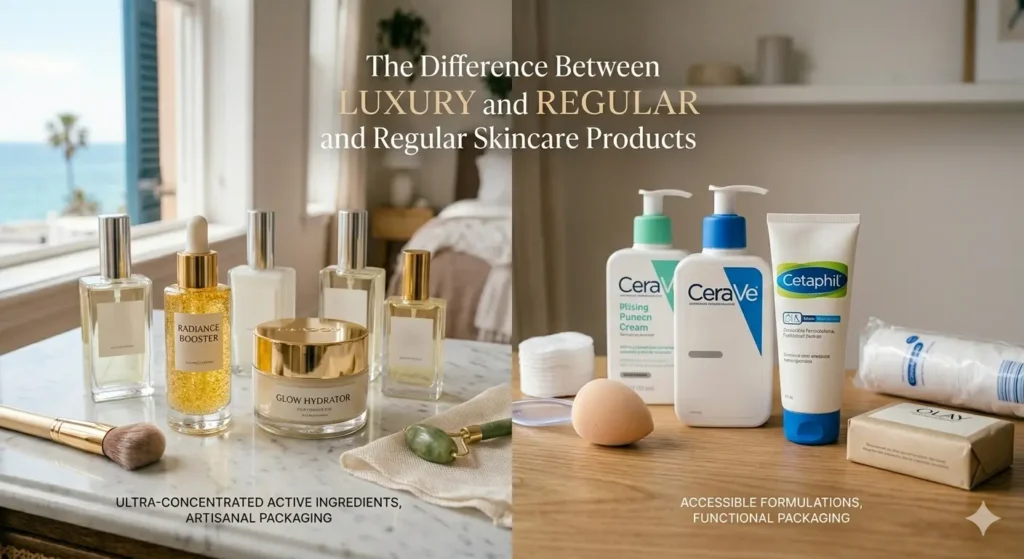
Active ingredients are the components of a skincare formulation that produce measurable changes in the skin — as distinct from the base, fragrance, or texture components that support delivery and experience. In premium skincare, the selection, concentration, stability, and delivery of these actives is where the most meaningful technical differentiation from standard products tends to occur.
Retinoids — including retinol, retinaldehyde, and tretinoin — remain the most extensively researched anti-aging actives in skincare. Their effectiveness in supporting cell turnover, collagen production, and the reduction of fine lines is well-documented. Luxury formulations often invest in encapsulation technology that stabilizes retinol and controls its release, reducing irritation while maintaining efficacy — a meaningful improvement over retinol simply added to a standard emulsion base.
Vitamin C in skincare works as an antioxidant, a brightening agent, and a cofactor in collagen synthesis. Its challenge is stability: L-ascorbic acid (the most potent form) is highly reactive and degrades rapidly on exposure to air and light. High-end skincare brands address this through more stable derivative forms (ethyl ascorbic acid, ascorbyl glucoside), UV-protective packaging, and airless delivery systems that preserve potency through the product’s life.
Peptides are short-chain amino acids that signal cellular behavior — stimulating collagen production, improving barrier function, or modulating muscle contraction (in the case of neuropeptides). Their concentration, combination, and delivery method all influence how effectively they function in a finished product — and luxury formulations tend to invest more heavily in the combination design and delivery systems that make peptide technology work.
Niacinamide (vitamin B3) is one of the most versatile and well-tolerated actives in skincare — effective across sebum regulation, barrier strengthening, hyperpigmentation management, and anti-inflammatory benefits. It is present across price points, but concentration and formulation context (what it’s combined with, at what pH) meaningfully influence its performance in a finished product.
Ceramides are the lipids that constitute the skin barrier’s fundamental architecture. Their inclusion in a moisturizer or treatment supports barrier integrity in a way that surface-level hydrators alone cannot. Luxury formulations often use multi-ceramide complexes alongside their natural cofactors (cholesterol and fatty acids) to replicate the skin’s own barrier lipid profile more accurately.
Hyaluronic acid at multiple molecular weights — a formulation approach more common in premium products — delivers hydration at different skin depths simultaneously, producing a more durable and visually plumping effect than single-weight versions. This multi-weight approach represents a genuine formulation investment rather than simply a marketing claim.
Are Luxury Skincare Products Worth the Investment?
The honest answer is: it depends on what you’re investing in — and what you expect in return.
Ingredient quality and concentration are the most defensible reasons to invest in premium skincare. If you are targeting specific concerns — advanced photoaging, persistent hyperpigmentation, barrier compromise — and the luxury formulation genuinely delivers higher concentrations of clinically validated actives in more stable, better-delivered forms, the investment is rational on functional grounds.
Brand expertise matters when it reflects real formulation history and R&D investment rather than simply brand positioning. The brands that have maintained premium formulation standards across decades — rather than those that arrived at luxury pricing through marketing rather than science — offer a form of quality assurance that is difficult to replicate at lower price points.
Long-term skincare routines are where the investment case is strongest. Skincare works through consistency over time, not through occasional application of exceptional products. A product that costs more but is used consistently because it’s genuinely pleasurable to use may deliver better outcomes than a cheaper product that sits unused because its texture or performance never quite earned the daily habit. That compliance factor is real, and it is worth including in any honest cost-benefit analysis.
Personal preferences and expectations are legitimate factors. If the ritual of luxury skincare — the product experience, the sensory quality, the sense of investing deliberately in your own skin health — is something you value and sustain over time, that experiential return is not trivial. It is, however, personal — and it’s worth distinguishing from the functional skincare return when evaluating whether any specific product is worth its price.
Who Benefits Most from Premium Skincare?
Premium skincare delivers the most consistent return for a specific type of consumer — and it’s worth identifying whether that describes you before making significant investments.
Consumers seeking elevated skincare experiences — who find that the sensory quality and ritual of a premium product meaningfully influences how consistently they maintain their routine — typically extract more value from luxury skincare than those who view it as a purely functional transaction. The experiential dimension of luxury beauty products has real practical consequences for the people for whom it drives compliance.
Luxury beauty enthusiasts who have developed informed knowledge of ingredients, formulations, and skincare categories are well-positioned to evaluate premium products on their actual merits rather than their marketing — and to identify the specific formulations within any brand’s range that justify their price point most clearly.
Individuals prioritizing formulation quality and innovation — particularly those targeting advanced concerns like collagen loss, significant hyperpigmentation, or compromised barrier function — may find that the higher active concentrations, more sophisticated delivery systems, and greater R&D investment of luxury formulations deliver meaningfully different results than standard alternatives.
Those building comprehensive skincare routines — where multiple products need to work compatibly, complement each other’s benefits, and be sustained across years rather than weeks — often find that the coherence and consistency of a luxury skincare range supports this kind of sustained, multi-product investment more effectively than assembling a routine from disparate mass-market alternatives.
Common Myths About Luxury Skincare
A balanced understanding of luxury skincare benefits requires clearing away some persistent misconceptions that do consumers a disservice on both sides of the price spectrum.
More expensive always means better is the most pervasive myth in premium beauty. Price reflects many factors — ingredient cost, R&D investment, brand positioning, packaging, distribution channels, and marketing spend among them. A genuinely superior formulation usually costs more than a genuinely inferior one; but an expensive product is not necessarily superior to a moderately priced one, and the relationship between price and performance is not linear across the market.
Luxury products work instantly is a belief that leads to premature abandonment of products that would have delivered results over time. Skincare actives work through cumulative, sustained cellular influence — most clinical changes in collagen support, hyperpigmentation reduction, or barrier restoration require consistent use over a minimum of 8–12 weeks before they become visible. Expectations calibrated to skincare’s actual timeframe produce better outcomes and more honest product evaluations.
Medical-grade skincare replaces all luxury products overstates the clinical advantage of professional-grade formulations while understating the practical value of luxury skincare for daily maintenance, sensory experience, and routine sustainability. The categories serve different — and often complementary — purposes rather than competing for the same role in a consumer’s routine.
Packaging alone determines quality conflates luxury presentation with formulation substance. Beautiful packaging is a feature of genuinely excellent luxury skincare, but it is not evidence of it. The most reliable proxy for formulation quality remains the ingredient list — concentration, form, and combination — evaluated with some knowledge of what those ingredients actually do.
Frequently Asked Questions About Luxury Skincare
What are the main luxury skincare benefits?
The main luxury skincare benefits include higher concentrations of clinically relevant active ingredients, more sophisticated formulation technologies (encapsulation, multi-weight hyaluronic acid, liposomal delivery), superior packaging systems that preserve active potency, elevated sensory experiences that support consistent use, and brand-level R&D investment in proprietary formulation science. These benefits are most meaningful for consumers targeting specific skin concerns with products used consistently over time.
How does premium skincare compare to regular skincare products?
A direct premium skincare comparison shows that luxury formulations tend to differ most significantly in active ingredient concentration and stability, formulation delivery technology, packaging quality, and sensory experience. Regular skincare products can address foundational skin health needs effectively and are backed by strong clinical research in many cases. The most meaningful differences appear when targeting advanced concerns — anti-aging, brightening, barrier repair — where formulation sophistication and ingredient concentration have the greatest influence on outcomes.
Is medical grade skincare better than luxury skincare?
Neither category is universally superior. Medical grade skincare typically offers higher active concentrations suited to clinical concerns, distributed through professional channels with appropriate oversight. Luxury skincare offers elevated formulation quality with broader accessibility, superior sensory experience, and suitability for independent use across a wider range of skin types and concerns. For targeted clinical concerns, medical grade products — used under professional guidance — may be more appropriate. For daily maintenance and elevated skin health, luxury formulations often represent the stronger overall offering.
Are expensive skincare products worth the investment?
Expensive skincare products are worth the investment when the higher price reflects genuine formulation advantages — higher active concentrations, better delivery systems, superior ingredient quality, or meaningful R&D backing — that are relevant to your specific skin concerns. They are less clearly worth the investment when the price premium reflects primarily marketing, packaging aesthetics, or brand positioning rather than formulation substance. Evaluating the ingredient list and available clinical evidence, rather than price alone, is the most reliable basis for any skincare investment decision.
What ingredients are commonly found in luxury skincare products?
The ingredients most commonly found in well-formulated luxury skincare products include stabilized vitamin C (in forms such as ascorbyl glucoside or ethyl ascorbic acid), encapsulated retinol or retinaldehyde, multi-weight hyaluronic acid complexes, signal peptides and neuropeptides, multi-ceramide systems with cofactors, niacinamide, botanical actives from controlled-quality sources, and proprietary complex ingredients unique to specific brands (such as La Mer’s Miracle Broth or Augustinus Bader’s TFC8® complex). Explore our luxury skincare collections and anti-aging skincare products for formulations built around these actives.
Choose on Quality, Not on Price
The conversation about luxury skincare benefits is most useful when it moves away from price as the primary frame of reference and toward formulation quality, ingredient relevance, and personal goals. Premium skincare often delivers genuine advantages in ingredient concentration, delivery technology, and formulation sophistication — particularly for consumers targeting specific concerns with sustained, consistent routines. It also delivers experiential value — sensory quality, ritual, and brand confidence — that influences compliance in ways that functional analysis alone doesn’t capture.
Regular skincare, done well, addresses foundational skin health effectively and should not be dismissed as categorically inferior. And medical grade skincare, used under appropriate professional guidance, serves clinical concerns that neither luxury nor regular retail products are necessarily designed to address.
The most honest conclusion is also the most practical one: choose your skincare based on what the product actually contains, what your skin actually needs, and what you will actually use — consistently, daily, across the months and years that determine whether any skincare investment truly pays off.
Browse our beauty and wellness categories and premium skincare guides for curated, evidence-informed recommendations across all three tiers. And visit our professional skincare solutions if you’re considering a more targeted, clinical approach alongside your daily luxury routine.

 Brush
Brush Makeup Mirrors
 Body Lotions & Body Oils

 Personal Scales
 Perfume Coffrets
 Perfume Testers
 All Eyewear
 Unisex
 Optical
 Contact Lenses
 Home Fixtures
 Dining & Bar