


Latest posts
How to Choose Perfume for Your Personality?

There’s something quietly powerful about the right perfume. It enters a room before you do and lingers after you’ve left. It can anchor a memory, shift a mood, or signal something about who you are without a single word spoken. Yet for most people, choosing a fragrance still comes down to what smells pleasant on a test strip in a department store — which is roughly the equivalent of judging a book by its font.
Learning how to choose perfume with intention changes everything. It moves the decision from impulse to identity. This signature scent guide is designed to help you understand the language of fragrance — the families, the personalities, the occasions, and the seasons — so that every bottle you choose feels unmistakably like you.
Table of Contents
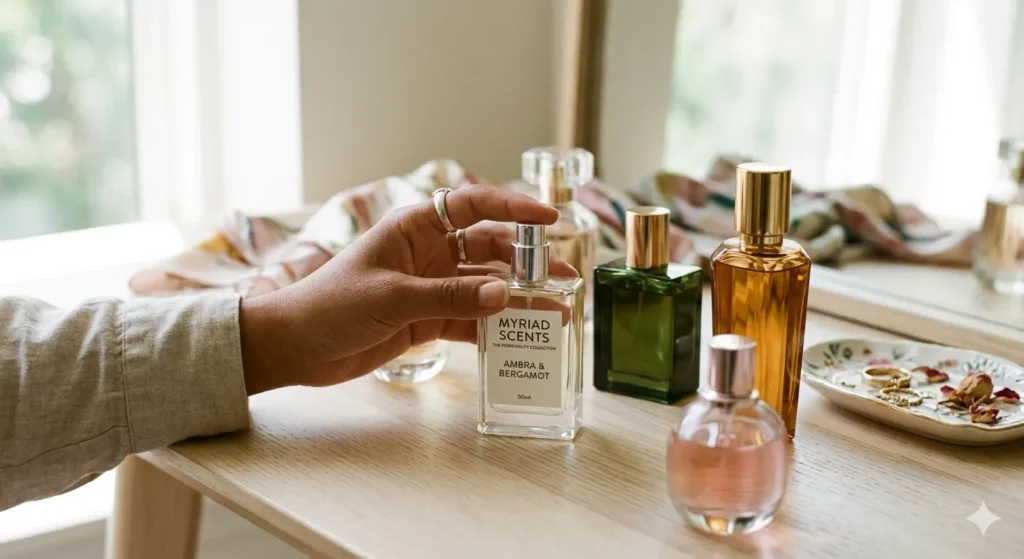
Understanding Fragrance Families
Before you can choose a perfume that suits your personality, you need to understand the building blocks. Fragrances are organized into families — broad categories that share a common character, emotional tone, and raw material profile. Think of them less as chemical classifications and more as emotional territories, each with its own mood, energy, and visual world.
This is where any honest luxury fragrance guide begins — not with specific bottles, but with the architecture of scent itself.
Floral Fragrances
Floral perfumes are the most expansive family in the fragrance world, ranging from the dewy freshness of a single white rose to the dense, almost narcotic warmth of tuberose or gardenia. They are not uniformly feminine or romantic — modern floral compositions can be green and sharp, powdery and nostalgic, or dark and complex. What unites them is a connection to nature in its most immediate, sensory form. Floral fragrances tend to suit people who are drawn to beauty with emotional depth — those who find comfort in elegance and carry a certain softness without sacrificing presence.
Woody Fragrances
Woody fragrances are grounded. Cedarwood, sandalwood, vetiver, patchouli — these are the notes that give a perfume weight, staying power, and a kind of dignified confidence. They sit close to the skin and develop gradually, which means they reward patience. People who gravitate toward woody scents often have a quiet authority about them. They don’t need to fill a room loudly. The warmth of a well-crafted woody perfume does it for them. These are scents for people who value substance over flash, and who find strength in stillness.
Oriental and Amber Fragrances
Rich, warm, and often intoxicating, oriental and amber fragrances are built around resins, spices, musks, and balsamic notes. Oud, benzoin, amber, and vanilla are common anchors. These are perfumes that make a statement — the kind you smell on someone and immediately want to ask about. They’re naturally associated with evening wear and luxury, but modern interpretations have made them surprisingly versatile. If you’re drawn to depth, to mystery, to the feeling of walking into a beautifully candlelit room, this family speaks your language.
Fresh and Citrus Fragrances
Bergamot, lemon, neroli, green tea, sea salt, aquatic notes — fresh and citrus fragrances are the most immediately appealing to most people precisely because they mimic the scents our brains already associate with cleanliness, energy, and clarity. They’re light, they’re vibrant, and they wear easily. These fragrances suit people who value simplicity and movement — those who are always slightly in motion, who prefer their style uncluttered, and who don’t want their perfume to be a conversation piece so much as a natural extension of their energy.
How Personality Influences Perfume Choice
Fragrance is deeply personal, but certain scent profiles consistently resonate with particular personality types. This isn’t a rigid formula — skin chemistry, mood, and memory all introduce variation. But understanding how your temperament relates to scent can dramatically narrow the search.
Elegant and Sophisticated Personalities
For those whose style leans toward the considered and refined — who dress with intention, choose quality over novelty, and feel most themselves in calm, curated environments — the ideal fragrances tend to be complex without being loud. Chypre compositions built on oakmoss and bergamot, or soft florals layered over woody bases, offer the kind of understated depth that suits an elegant sensibility. The goal is a scent that reveals itself slowly, that earns attention rather than demands it.
Bold and Confident Personalities
Bold personalities call for fragrances that match their energy — scents that project, that have an identifiable signature, and that don’t apologize for taking up space. Strong orientals, spicy oud compositions, and dark florals anchored by amber all work beautifully here. These are not subtle fragrances, and that’s exactly the point. If you’re someone who walks into a room with a plan, your perfume should feel like the exclamation mark on that entrance.
Minimalist and Understated Personalities
Minimalism in fragrance is genuinely difficult to execute well — a scent that communicates something meaningful while staying almost imperceptibly light requires real craft. But it exists, and it’s increasingly celebrated in the world of niche perfumery. Clean musks, quiet cedarwood accords, soft skin scents with barely-there citrus — these are fragrances for people who believe that restraint is its own kind of luxury. If your wardrobe is built on neutral tones and clean lines, your fragrance wardrobe probably belongs in the same aesthetic universe.
Creative and Artistic Personalities
Creative personalities tend to be drawn to fragrances that defy easy categorization — scents that make you pause and wonder what you’re smelling, that combine notes in unexpected ways, or that reference something specific and literary. Niche fragrance houses like Maison Margiela’s Replica line, or perfumes built around non-obvious inspirations (cold libraries, vintage record stores, morning earth after rain), tend to appeal to artistic sensibilities. These people want their perfume to have a story, and they want to be the only person in the room wearing it.
Finding Your Signature Scent
A signature scent isn’t the perfume you grab because it’s popular or because someone complimented it once. It’s the one that, when you spray it, feels like putting on the best version of yourself. Finding it takes time and intentional exploration — but it’s entirely worth the effort.
The most important practical rule when testing fragrances is to resist the test strip. Smelling a fragrance on card stock tells you approximately one-third of the story — the top notes, which are the most volatile and typically evaporate within 20 minutes. The heart notes and base notes, which are the true character of a perfume, only reveal themselves on skin. Always test on your wrist or inner elbow, wait at least 30 minutes, and then decide.
Skin chemistry is not a marketing myth. The same fragrance can smell radically different on two people because of variations in skin pH, moisture levels, and diet. A perfume that smells powdery and soft on one person can read as sharp or musky on another. This is why borrowing someone else’s “holy grail” rarely works as predicted — and why the only reliable way to find yours is to wear it yourself.
When a fragrance works, you’ll know it not just because it smells good, but because you stop noticing it separately from yourself. It becomes part of how you present to the world. That’s the threshold you’re looking for. Our signature scent recommendations are a good starting point if you’re ready to begin exploring with direction.
Day vs Night Scents — Choosing for the Occasion
Context matters enormously in fragrance. A perfume that feels perfectly appropriate and magnetic in the evening can feel overwhelming, inappropriate, or simply wrong during the day. Understanding day vs night scents is less about rigid rules and more about reading the room — and the light.
Light Daytime Fragrances
Daytime fragrances benefit from lightness, freshness, and easy projection. They shouldn’t compete with your environment — a meeting room, a café, a busy office. Citrus-forward scents, green florals, aquatic compositions, and light musks all work beautifully in daylight hours. They’re energizing without being assertive, and they tend to be widely inoffensive, which matters when you’re sharing air with other people.
Rich Evening Perfumes
Evening is where fragrance gets to breathe and expand. Darker, richer compositions — orientals, heavy florals, smoky woods, oud-based scents — come into their own in low light and warm settings. The depth and sillage (the trail a perfume leaves) that would be too much in a daytime context become exactly right when you’re dressed for dinner or a late-night event. Evening fragrance should feel like an event in itself.
Work-Friendly Luxury Scents
The workplace is its own fragrance category. The ideal work scent is professional, clean, and never so powerful that it becomes a distraction for colleagues. Soft woods, restrained musks, subtle citrus, and understated aquatics all sit well in professional environments. Many luxury fragrance houses produce beautiful compositions that wear quietly at low projection — sophisticated without announcing themselves.
Romantic and Special-Event Fragrances
For occasions that carry emotional weight — a first date, an anniversary, a celebration — the fragrance you choose becomes part of the memory itself. These are the moments for your most evocative scents: warm skin musks, complex florals, amber-heavy orientals. The goal isn’t to overpower but to linger — to be the scent someone remembers when they think of that evening.
Seasonal Perfume Selection
Just as you adapt your wardrobe to temperature and light, seasonal perfume selection is one of the most intuitive and rewarding ways to keep your fragrance relationship feeling fresh and considered.
Fresh Fragrances for Spring and Summer
Warm months call for lighter compositions that feel comfortable in heat rather than amplified by it. Heat intensifies fragrance projection significantly — a perfume that wears beautifully in winter can become overwhelming on a 35-degree afternoon. Citrus, green, and light floral scents are natural companions to spring and summer. They feel clean in humidity, they complement sun-warmed skin, and they carry a natural sense of optimism that matches the season’s energy.
Warm and Sensual Scents for Autumn and Winter
As temperature drops, skin absorbs and holds richer compositions more comfortably, and the emotional register of the season invites something warmer and more interior. This is the time for spiced orientals, woody ambers, vanilla-infused musks, and smoky ouds. These are fragrances that feel like warmth — that have a physical weight to them and create a cocoon-like sense of comfort. Autumn and winter are when the boldest, most complex bottles in your collection earn their place.
Transitional Fragrances for Year-Round Wear
Some fragrances exist outside the seasonal conversation entirely — clean musks, restrained woody compositions, and certain soft florals wear with equal ease in June and December. These are valuable anchors for a fragrance wardrobe because they remove the decision-making entirely. When in doubt, they’re always appropriate. Every collection benefits from at least one or two transitional scents that act as reliable defaults.
How to Build a Luxury Fragrance Wardrobe?
The concept of a fragrance wardrobe — owning multiple perfumes for different contexts, moods, and seasons — has moved from a niche habit of serious collectors to a mainstream approach to personal style. It reflects a more sophisticated understanding of what fragrance can do when treated as intentionally as clothing.
The foundation of a thoughtful collection is balance. A strong wardrobe typically includes a fresh daytime option, a richer evening or occasion scent, a seasonal rotation piece, and a signature — the one you reach for when you simply want to feel most like yourself. Beyond those pillars, everything else is exploration.
When it comes to luxury fragrances, the guidance is consistent: invest in quality over quantity. A well-crafted perfume from a respected house — whether a heritage brand or a niche independent — will reward you with better ingredients, more complex evolution, and significantly better longevity than a budget alternative. One exceptional bottle worn regularly creates more identity and more emotional value than a shelf full of mediocre ones.
Balancing timeless classics with newer releases keeps your collection alive rather than static. But the classics earn their place because they’ve proven their worth across decades — and there’s something deeply satisfying about wearing a fragrance that has been part of human culture for longer than you’ve been alive. Explore our luxury perfume collections to find compositions built to last.
Common Mistakes People Make When Choosing Perfume
Even people with genuinely good taste make predictable errors when it comes to fragrance. Knowing what to avoid is almost as useful as knowing what to look for.
Over-testing is the most common trap. Walking through a fragrance department and spraying eight things on your skin and five on cards guarantees olfactory fatigue — your nose becomes unable to accurately process what it’s smelling after three or four encounters. Limit yourself to two or three skin tests per visit, and take breaks by smelling something neutral (your own sleeve, surprisingly, works well).
Choosing trends over personality is a subtler mistake but an equally costly one. The most celebrated fragrance of the moment may genuinely not suit you — and wearing something because it’s culturally current rather than personally resonant means you’ll rarely reach for it. Fragrance trends cycle quickly; your personality doesn’t.
Ignoring dry-down evolution is the direct consequence of judging a fragrance on its opening. The top notes of most perfumes are designed to be immediately appealing — they’re the hook. But the dry-down, the phase 30 to 60 minutes after application, is where the true character reveals itself. A fragrance that opens with bergamot and rose might dry down to a rich, resinous wood base that bears little resemblance to its first impression. Always wait.
Wearing overpowering scents in the wrong settings damages both your impression and the fragrance itself. Heavy orientals and dense oud compositions that feel magnificent at a dinner party become oppressive in an elevator or a small meeting room. Read the context before you reach for a bottle — or develop the habit of adjusting your spray count based on setting.
How to Make Perfume Last Longer?
Longevity is partly determined by the concentration of a fragrance — Eau de Parfum lasts significantly longer than Eau de Toilette, and Extrait de Parfum longer still. But application method matters just as much as what’s in the bottle.
Pulse points — the inner wrists, behind the ears, the base of the throat, the inner elbows, and behind the knees — are where blood vessels sit close to the surface of the skin, generating subtle warmth that continuously activates and lifts fragrance. Applying perfume to these points distributes it in a way that moves with your body rather than sitting statically in one place.
Moisturized skin holds fragrance longer than dry skin. Applying an unscented moisturizer or a matching body lotion before your perfume gives the scent molecules something to cling to, extending projection and longevity noticeably. Some houses offer matching body products for their signature scents specifically for this purpose — a technique called layering that builds a more complex and longer-lasting overall effect.
Storage is frequently overlooked. Perfume degrades when exposed to light, heat, and fluctuating temperature. Keep your bottles away from bathroom shelves (humidity and heat are damaging), away from windowsills, and ideally in a cool, dark drawer or cabinet. A well-stored perfume can remain in excellent condition for five years or more; a poorly stored one may degrade in months.
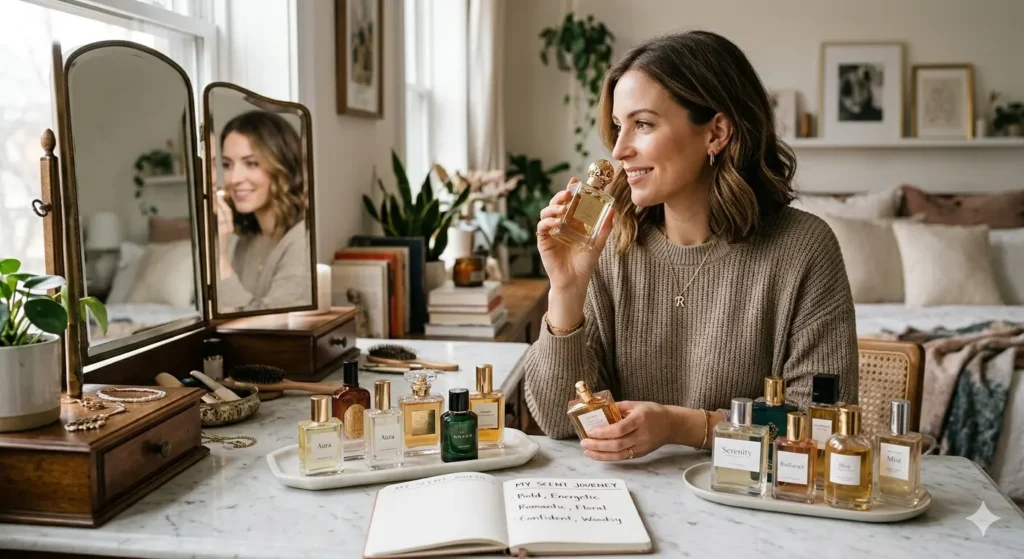
Frequently Asked Questions About Choosing Perfume
How do I choose the right perfume for my personality?
Start by identifying which fragrance family resonates with your temperament — floral for those drawn to elegance and warmth, fresh and citrus for energetic and minimal personalities, woody for the quietly confident, and oriental for those who prefer depth and drama. Test on skin, not paper, and choose the scent that feels like the most natural extension of who you already are.
What fragrance family is most popular?
Floral fragrances are consistently the most widely purchased globally, owing to their versatility across genders, occasions, and ages. Within niche and luxury perfumery, woody and oriental fragrances have grown significantly in popularity as consumers seek more distinctive, long-lasting compositions.
How can I find my signature scent?
The process requires patience. Test fragrances on skin across multiple visits, always allowing full dry-down before deciding. A signature scent reveals itself when you stop noticing it separately from yourself — when it simply feels like you. Exploring curated signature scent recommendations organized by personality type can accelerate the process considerably.
What is the difference between day and night perfumes?
Day fragrances are typically lighter, fresher, and lower in sillage — designed to be pleasant in shared spaces without dominating. Evening fragrances are richer, more complex, and project more freely — built to make an impression in social settings where intensity is appropriate rather than intrusive.
How should perfume change by season?
Warm seasons call for lighter, fresher compositions that perform well in heat without overwhelming. Cooler seasons invite warmer, denser, more resinous scents that complement cold air and complement layered clothing. Transitional fragrances — clean musks, soft woods — work year-round and form a reliable foundation regardless of season.
The Art of Choosing Intentionally
Perfume is one of the few things we wear that exists entirely in the realm of feeling. It doesn’t photograph. It doesn’t display in a window. It communicates something that only those physically close to you will ever experience — which makes it uniquely intimate, uniquely personal, and uniquely powerful as an expression of identity.
The most memorable fragrances in your collection will not be the most expensive ones, or the most trending ones, or the ones someone else recommended. They’ll be the ones that, when you spray them, settle into your skin as if they were always supposed to be there. That quality — of felt rightness — is what every element of this guide has been pointing toward.
Choose with intention. Explore our women’s fragrances, men’s fragrances, and seasonal fragrance collections to begin building a wardrobe that reflects the full range of who you are — not just who you are today, but who you’re becoming.

 Brush
Brush Makeup Mirrors
 Body Lotions & Body Oils

 Personal Scales
 Perfume Coffrets
 Perfume Testers
 All Eyewear
 Unisex
 Optical
 Contact Lenses
 Home Fixtures
 Dining & Bar