


Latest posts
Kids’ Fashion That Lasts: Style, Comfort & Confidence for Every Occasion

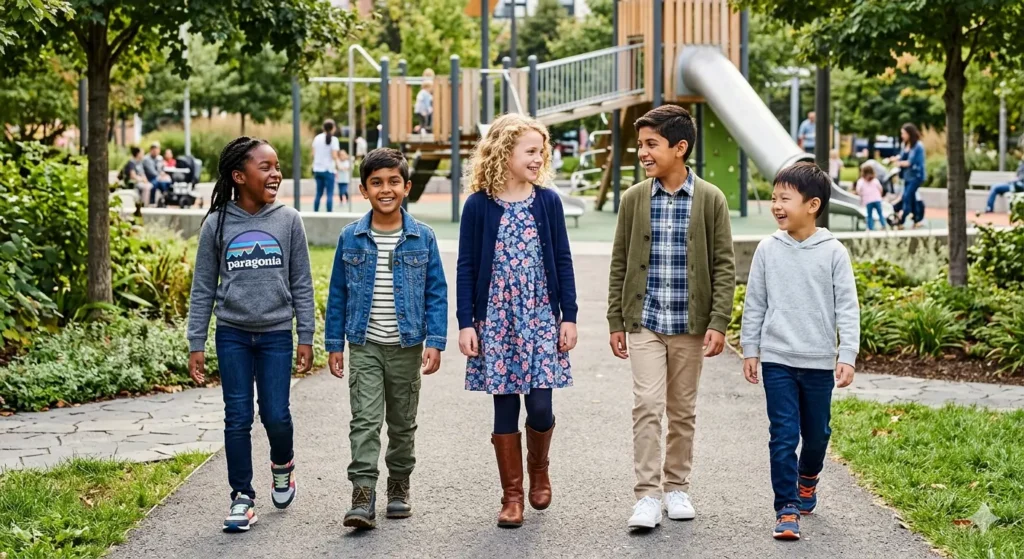
There is something quietly profound about watching a child dressed in clothes that feel genuinely right for them — not squeezed into something stiff for a photograph, not layered in fabrics that scratch by mid-morning, but clothed in something that moves as freely as they do. Kids fashion has undergone a significant shift in recent years, and the conversation has matured considerably. Parents today are thinking differently about what they put on their children — asking not only whether something looks beautiful, but whether it will hold up through an afternoon at the park, survive a school week, and still feel worth wearing when the next season arrives.
This is where premium children’s clothing earns its place. Not through price alone, but through the considered decisions that go into designing garments for small people who live — fully, physically, joyfully — inside their clothing all day long. Quality fabric. Thoughtful construction. Proportions that respect the body of a child rather than simply miniaturising adult aesthetics. These are the qualities that define luxury fashion for kids, and they are precisely the qualities that make the investment worthwhile for families who care about both the practical and the beautiful.
This guide explores five pillars of modern children’s dressing — from the breathable everyday fabrics that carry children through their busiest hours to the coordinated family looks redefining how modern parents approach occasion dressing together.
Table of Contents
Why Comfort Matters More Than You Think in Everyday Kids Fashion?
The Relationship Between Clothing and Confidence
Ask any parent of a school-age child and they will confirm what most instinctively know: discomfort is distracting. A waistband that bites, a collar that chafes, a fabric that traps heat — these are not minor inconveniences for a child. They are persistent interruptions to concentration, play, and simply feeling at ease in their own skin. Clothing that fits well and feels good from morning to evening is not a luxury consideration for children. It is a foundational one.
There is also a quieter, more emotionally significant dimension to this. Children who feel comfortable in what they are wearing carry themselves differently. The fidgeting stops. The confidence that comes from not thinking about what you have on — that particular freedom — allows personality to take the foreground instead. This is why the best children’s luxury wear prioritises wearability as a design principle from the first sketch, not as an afterthought applied once the silhouette has been decided.
What Comfort-First Design Actually Looks Like?
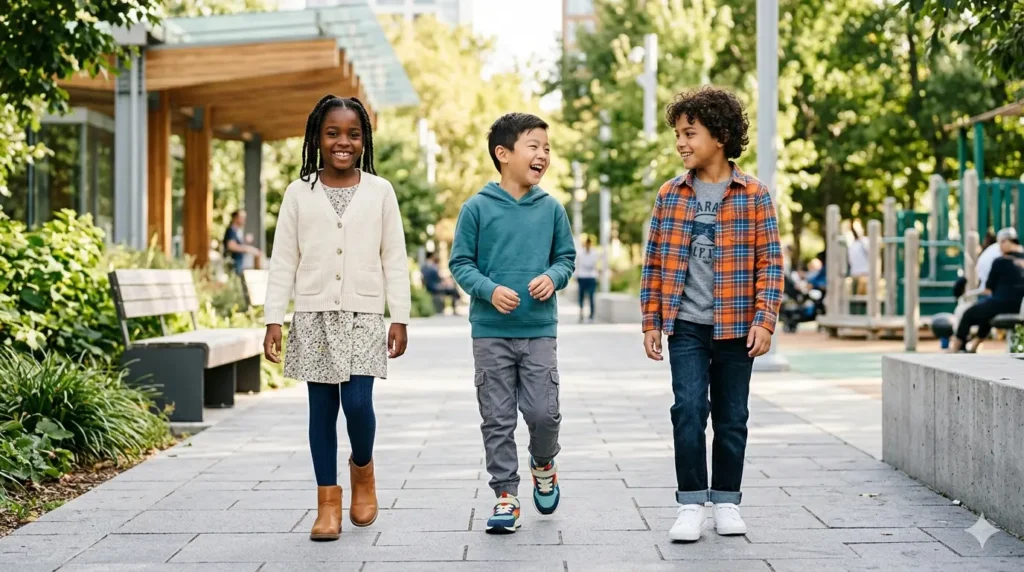
In practical terms, comfort-first design shows up in specific ways: flat seams that don’t press against skin, waistbands with gentle elastication that yields rather than grips, necklines that slip on easily without a battle, and sleeve lengths that account for the way children actually use their arms. It shows up in breathable linings inside structured pieces, in adjustable closures that accommodate growth, and in the kind of considered sizing that doesn’t assume all children of the same age share the same proportions.
Comfort wear for children doesn’t mean shapeless or unremarkable. Some of the most elegant garments in contemporary kidswear achieve their effect through the softness of the fabric and the precision of the cut — not through embellishment or structural complexity. A beautifully draped dress in washed linen. A perfectly proportioned cotton poplin shirt. A softly tailored blazer in a fabric that moves. These are pieces that look considered because they are, and that feel easy because ease was genuinely built into them.
Durable Fabrics That Keep Up With Active Children
The True Cost of Poorly Made Children’s Clothing
Children are physically demanding on their clothing in a way that adult garments rarely face. The knees of trousers bear the weight of a hundred crouching moments. The cuffs of shirts absorb everything from lunch to craft materials. Outerwear gets bundled, sat on, pulled on and off dozens of times a day. Fast-fashion garments designed to a price point rarely survive this kind of treatment beyond a season — which means parents who make the budget choice repeatedly often spend more in total than those who invest in pieces built to last.
This is one of the clearest arguments for trendy kidswear 2026 that prioritises fabric integrity and construction quality. A well-made pair of children’s trousers in heavy-gauge cotton or a durable ripstop weave holds its shape and colour through repeated washing in a way that cheaper alternatives simply cannot. The stitching doesn’t unravel at the knees. The zip continues to function. The hem doesn’t drop. The piece earns its place across multiple seasons — often passing between siblings rather than ending up in a charity bag after six weeks.
Fabrics Worth Looking For
The most reliable children’s wardrobe is built around a considered selection of materials, each chosen for a specific purpose:
- Organic cotton — Soft against sensitive skin, breathable in warm weather, and resilient enough for regular washing; the backbone of any well-considered children’s wardrobe
- Cotton-linen blends — Particularly effective for warmer months; the linen adds structure and weight while the cotton keeps the fabric soft and manageable
- Jersey knit — Ideal for everyday comfort wear; it moves with the body, resists wrinkling, and recovers its shape consistently
- Brushed cotton and flannel — The fabrics of colder mornings and weekend layers; soft immediately rather than requiring breaking-in
- Technical weaves — For outerwear and activewear, fabrics with built-in water resistance or wind protection that maintain their performance properties after repeated use
The Mengotti kidswear edit approaches fabric selection with the same seriousness applied across its broader fashion offer — sourcing materials that justify the investment and reward close inspection.
How to Care for Children’s Premium Clothing?
The longevity of quality children’s garments also depends on how they are laundered. A few straightforward habits extend the life of premium pieces considerably: washing at the temperature recommended on the care label rather than defaulting to high heat, turning garments inside out to protect surface fibres and colour, and air-drying structured pieces rather than machine-drying where possible. None of these practices require significant time — they simply require the intention.
Mini Couture: Luxury Fashion Designed for Children
When Design Takes Children Seriously
The category of mini couture — children’s clothing conceived with the same creative seriousness applied to adult ready-to-wear — has grown considerably in recent years, and the best of it is genuinely interesting as fashion. Not scaled-down adult aesthetics imposed on small bodies, but clothing that understands the particular proportions, movement patterns, and joyful energy of childhood and works with them rather than against them.
Luxury fashion for kids, at its best, brings in considered details that elevate without complicating: a hand-stitched collar, a contrast lining in a printed fabric that appears when a sleeve is rolled up, a pocket placed precisely where a child’s hand naturally falls, smocking done by hand on a Sunday dress that will be worn and worn and eventually passed on. These are the details that photograph beautifully and feel special to the child wearing them — which is ultimately the more important of the two.
Seasonal Versatility as a Design Principle
One hallmark of well-designed children’s luxury clothing is its seasonal flexibility. A fine-knit cardigan that layers over a summer dress in spring and over a long-sleeve shirt in autumn. A structured coat with a removable lining that transitions from October through February without looking like a concession. Trousers in a neutral tone that carry through multiple seasons and work with the majority of what a child already owns.
This kind of versatility is rarely an accident. It requires a deliberate approach to colour, weight, and silhouette — one that considers the full lifecycle of a garment rather than its impact in a single season. For parents building children’s wardrobes thoughtfully rather than reactively, these are the pieces worth identifying and investing in. They reduce decision fatigue, simplify getting dressed in the morning, and ultimately cost less per wear than the seasonal novelties they replace.
Stylish Outfits for Special Occasions and Daily Wear
Occasion Dressing Without the Compromise
The challenge of children’s occasion dressing is familiar to most parents: finding something that looks genuinely lovely, can be worn for an entire event without a meltdown caused by physical discomfort, and doesn’t require ironing seven times before anyone has taken a single photograph. These three requirements are not mutually exclusive — but finding all three in a single garment requires knowing where to look.
The most successful stylish outfits for children’s special occasions share certain characteristics. The fabrics are smooth rather than stiff — duchess satin has its place, but organza layers that scratch are nobody’s friend. The silhouette is age-appropriate in a way that allows for sitting, running when the children inevitably break free from adult supervision, and dancing if the occasion calls for it. The colour palette is considered — not overly precious or difficult to accessorise, but beautiful enough to feel genuinely celebratory.
Building a Children’s Wardrobe With Longevity in Mind
A practical framework for building a children’s wardrobe that covers both daily life and special occasions without excessive spending looks something like this:
Everyday foundation pieces:
- Neutral-toned quality cotton trousers and shorts in two or three core colours
- A selection of plain and simply patterned cotton tops in rotating tones
- One or two jersey dresses or pinafores that layer across seasons
- A well-made pair of denim with reinforced knees and a proper rise
For smarter occasions:
- One or two dresses or suits in quality fabric that can be revisited for multiple events
- A blazer or structured jacket in a neutral that works across different outfits beneath it
- Simple, elegant footwear that prioritises fit and support alongside aesthetics
Layering pieces for year-round use:
- A fine-knit cardigan in a neutral shade
- A quality cotton hoodie or zip-through for transitional weather
- One considered coat in a classic shape and tone
This isn’t an exhaustive list — every child’s life has its own rhythm and its own occasions. But the logic holds: fewer, better pieces create a more functional and more beautiful wardrobe than a volume of compromises.
Dressing Children With Confidence in Mind
There is a conversation worth having about the connection between how children are dressed and how they feel about presenting themselves to the world. Not in the sense that clothing determines self-worth — it absolutely does not — but in the quieter sense that feeling good in what you’re wearing is a form of readiness. A child who arrives at a school event, a family gathering, or a first day in something that feels right to them — something comfortable, something they recognise as theirs — enters that situation from a slightly stronger position than one who doesn’t.
Luxury fashion for kids contributes to this when it’s done well. Not because it carries a label, but because quality clothing communicates care — to the child wearing it and to those around them.
Matching Family Looks and Modern Parenting Trends
The Rise of Co-ordinated Family Dressing
Matching family looks have moved a considerable distance from the slightly forced coordinated Christmas photograph of a previous era. Contemporary family fashion — the kind appearing across editorial shoots, travel imagery, and the wardrobes of parents who think carefully about aesthetics — is less about identical outfits and more about a shared visual language. The same colour palette interpreted at different scales. A print that appears in a child’s dress and reappears as a detail in a parent’s accessory. Tonal dressing that creates cohesion without uniformity.
This approach to co-ordinated dressing reflects a broader shift in how families engage with fashion together. Rather than dressing children as an afterthought to adult wardrobe decisions, or purchasing entirely separately in ways that never visually connect, there is an increasing appetite for a considered family aesthetic — one that photographs well, travels well, and communicates something genuine about shared values and taste.
How to Create Family Co-ordination Without Over-Matching
The most elegant family co-ordination is achieved through restraint rather than precision matching. A few practical principles make this easier to execute:
- Anchor to a shared palette — choose two or three tones that appear across adult and children’s pieces without requiring identical garments
- Echo prints rather than duplicating them — a floral detail in a child’s dress and the same floral print in a woman’s scarf creates a relationship without becoming a costume
- Match the occasion register — if the adults are dressed at a particular level of formality, children’s clothing should sit at a similar register rather than significantly above or below it
- Let accessories do the connecting work — co-ordinating shoes, hats, or bags across the family can create strong visual coherence without touching any of the primary garments
Mengotti’s approach to family fashion considers both the adult and children’s wardrobes as part of a complete lifestyle aesthetic — making it a natural starting point for parents building a co-ordinated family wardrobe with quality at its foundation.
Why Modern Parents Are Investing Differently?
The parents who are thinking most carefully about trendy kidswear 2026 are, by and large, applying the same principles to children’s clothing that they apply to their own wardrobes: buying less, buying better, and expecting what they buy to last. The throwaway kidswear model — piles of inexpensive pieces cycled through seasons and discarded without sentiment — sits increasingly uncomfortably alongside a growing awareness of both environmental impact and genuine value.
Investing in children’s clothing that holds its quality means pieces that can be passed down to younger siblings or cousins in genuinely good condition. It means not replacing the same category of item every eight weeks because the previous purchase has failed. It means children developing an early relationship with the idea that clothing has value, is worth caring for, and represents a considered choice rather than a disposable convenience. These are not trivial lessons.
Clothing That Grows With Them — In Every Sense
There is a particular kind of satisfaction in watching children inhabit their clothing with complete unselfconsciousness — running, climbing, laughing, pulling faces in every photograph, and somehow still managing to look exactly as you hoped they would. That experience doesn’t happen by accident. It happens when the clothing is genuinely right for them: comfortable enough to forget, beautiful enough to matter, and well-made enough to carry the moments that get lived inside it.
Kids fashion at its best is not about impressing anyone. It’s about giving children the freedom to be entirely themselves, dressed in something that supports rather than restricts that freedom — and occasionally, quietly delights both of you.
Mengotti’s children’s fashion and kidswear collections bring the same commitment to quality, thoughtful design, and considered curation that defines every category across the brand. For families who are building wardrobes with intention, it is a destination worth exploring.

 Brush
Brush Makeup Mirrors
 Body Lotions & Body Oils

 Personal Scales
 Perfume Coffrets
 Perfume Testers
 All Eyewear
 Unisex
 Optical
 Contact Lenses
 Home Fixtures
 Dining & Bar