


Latest posts
Tom Ford vs Oliver Peoples Sunglasses — Luxury Power vs Subtle Minimalism

There are two ways to wear luxury quietly. The first is to wear something so understated that only the people who truly understand design recognize what you have. The second is to wear something so precisely, so confidently constructed that its boldness becomes its own form of authority — not loud, exactly, but entirely unwilling to be overlooked. Tom Ford vs Oliver Peoples sunglasses represents this distinction at its most instructive — two brands, both serious about design, both premium in their construction, but philosophically opposed in almost every way that matters for the buyer trying to understand which one actually belongs to them.
Oliver Peoples has spent nearly four decades building the case for the first kind of luxury — the warm, vintage-informed California minimalism that reveals itself slowly, rewards attention over display, and serves the wearer by making them look more completely like themselves. Tom Ford has spent two decades building the case for the second — the bold, dramatically proportioned, overtly confident design language of a man who came from fashion’s most image-conscious world and brought its visual ambition directly into eyewear.
This luxury eyewear comparison maps both brands honestly across every dimension that matters — design philosophy, key models, materials, cultural identity, and the specific guidance that resolves whether TF or OP is better for men and women who want to make the right choice the first time.
Table of Contents
The Founders’ Visions — Where Each Brand Begins?
Every meaningful bold luxury vs subtle luxury comparison requires understanding the creative intelligence that shaped each brand — because these are not anonymous manufacturing operations producing frames to market specifications. They are expressions of specific creative visions applied to wearable objects.
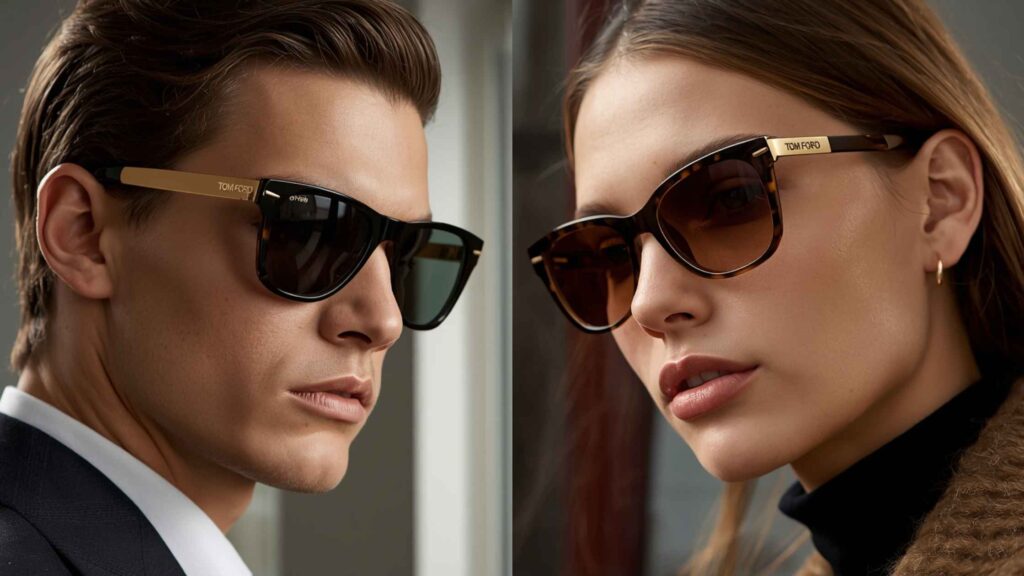
Tom Ford built his first eyewear collection in 2005 — two years after leaving Gucci, where he had redefined luxury fashion’s visual language for a generation by combining cinematic glamour, overt sensuality, and the kind of commanding aesthetic authority that makes a room stop when it walks in. His eyewear carried the same ambitions. Large, dramatic, architecturally considered, and built with the understanding that a frame should make an immediate and unambiguous claim about the person wearing it. Tom Ford didn’t design frames for people who wanted to blend in. He designed them for people who had decided that standing out, done with genuine design intelligence, was the more honest choice.
Larry Leight opened the first Oliver Peoples boutique on Sunset Boulevard in 1987 with a completely different conviction — that the most sophisticated eyewear was the kind that had already existed, been refined through decades of optical tradition, and earned its design authority through longevity rather than impact. The brand’s vintage archive orientation, its California design ease, and its consistent investment in proprietary acetate colorways and Japanese manufacturing standards all reflect a founder’s vision of luxury as something discovered rather than declared. OP frames are for people who have looked carefully at design history and found the right thing — not the loudest thing, not the most dramatic thing, but the right thing.
These founding visions — Tom Ford’s cinematic declaration versus Oliver Peoples’ quiet discovery — generate every design difference between the brands and explain every aesthetic choice their current collections make.
Design Philosophy — The Core Contrast
The fundamental design tension in the Tom Ford vs Oliver Peoples sunglasses comparison is captured most precisely in the question of what a frame should do on the face — whether its primary function is expressive or revelatory.
Tom Ford’s design philosophy is expressive. Frames in the TF catalog are built to communicate — to project a specific aesthetic identity that is clear, confident, and immediately readable. The brand’s characteristic design moves — the T logo at the temples, the bold acetate proportions, the dramatic cat-eyes and oversized squares that define the women’s range, the strong masculine geometry of the men’s collection — are all in service of this expressive ambition. A Tom Ford frame changes how you appear. It adds something to your presence that wasn’t there before, amplifying the visual statement your overall look is making.
Oliver Peoples’ design philosophy is revelatory. OP frames are built to reveal — to make visible the taste and intelligence already present in the wearer rather than adding something new. The brand’s restraint, its vintage design wisdom, its warm acetate colorways calibrated for California light — these are all in service of the conviction that the best frame is the one that makes the person wearing it look most completely like themselves. An Oliver Peoples frame doesn’t change how you appear. It clarifies it.
Neither philosophy is superior. They serve different personalities and different relationships with self-expression through fashion. Understanding which philosophy resonates more honestly with your own is the most important analytical step in this comparison.
Tom Ford Sunglasses — The Bold Luxury Case
Tom Ford’s eyewear catalog is among the most commercially successful and most culturally visible in the luxury market — and understanding what it offers at its best requires engaging with the brand’s specific design strengths rather than simply cataloguing its most dramatic pieces.
The Women’s Collection — Cinematic Feminine Authority
Tom Ford’s women’s eyewear is built around a consistent design conviction: that feminine luxury, done at the highest level, should be unapologetic in its visual ambition. The TF0539 butterfly and related oversized constructions create a scale of face coverage that is deliberately cinematic — the frames reference Hollywood’s golden era glamour in the specific sense of creating a visual frame around the face that photographs as dramatically as it appears in person.
The TF0634 cat-eye is among the most technically accomplished cat-eye constructions in the accessible luxury market — the upswept geometry precisely calibrated, the acetate quality good, and the overall design register one that rewards the confidence required to wear it without appearing to try. These are frames for women who have already decided they want to be seen and want the seeing to happen on terms they’ve established.
The Men’s Collection — Masculine Geometric Confidence
For men women frames comparisons, Tom Ford’s men’s collection is the most consistently strong argument the brand makes for its design philosophy in a masculine register. The TF0753 and related square constructions carry a geometric authority that is specific to the brand — heavier acetate than Oliver Peoples uses, bolder proportions, and the TF logo hardware that announces the brand identity with a directness that OP’s temple branding never attempts.
TF or OP better for men is a question that resolves clearly within the men’s collection specifically: Tom Ford is better for the man who wants his eyewear to make a definitive masculine statement — who dresses with the kind of bold confidence that needs a frame strong enough to match it. The brand’s men’s pieces carry their weight with genuine authority, and for the right wardrobe, that weight is exactly what’s called for.
The Signature TF Hardware
The T-bar logo at the temples is Tom Ford’s most discussed and most significant brand signal in eyewear — and its treatment reflects the brand’s broader design philosophy. It’s not subtle. It’s not trying to be subtle. It communicates brand identity immediately and without apology, which is exactly what the brand intends. For buyers in whom that immediate communication is part of the value proposition — who want their luxury to be legible to the wider world rather than only to the initiated — the TF hardware is a feature rather than a limitation.
Oliver Peoples Sunglasses — The Subtle Luxury Case
Oliver Peoples’ design language is the most fully developed expression of California luxury minimalism in the eyewear market — and its best frames demonstrate that restraint, applied with genuine intelligence, creates objects of extraordinary quality and satisfaction.
The Gregory Peck — Canonical Round Authority
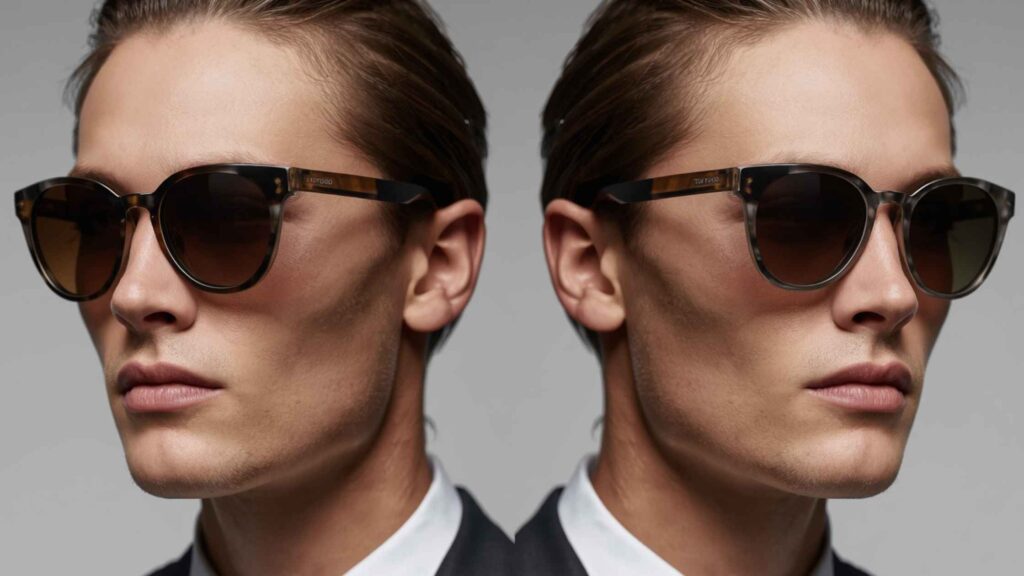
The Gregory Peck is not simply Oliver Peoples’ best frame. It is among the best-designed frames in the accessible luxury eyewear market by any evaluative standard — proportions developed through decades of refinement, Mazzucchelli acetate in proprietary colorways that respond to California light with a warmth no competitor replicates, and an overall design register of vintage authority that feels inevitable rather than designed. Wearing it doesn’t feel like wearing a brand. It feels like wearing the right thing.
The Sheldrake — Versatile Professional Excellence
The Sheldrake demonstrates Oliver Peoples’ ability to apply its design intelligence to a more practically oriented brief — a modified rectangle that works across every context in a wearer’s daily life without friction or compromise. It’s the frame that makes the strongest case for OP in the OP vs TF 2026 review for buyers whose primary requirement is genuine cross-context versatility rather than design impact.
The Cary Grant and O’Malley
These two frames extend the brand’s core design intelligence into territories that the Gregory Peck and Sheldrake don’t fully cover — the Cary Grant’s geometric precision serving buyers who want architectural clarity within OP’s warm design language, the O’Malley’s keyhole bridge construction offering character alongside the brand’s characteristic versatility. Together, these four frames define a design world comprehensive enough to serve most buyers’ complete eyewear needs.
Materials — What Each Brand Builds With?
Luxury eyewear comparison at this level requires honest material assessment — because both brands make premium quality claims that deserve specific examination.
Tom Ford sources quality acetate and uses good metal alloys across the collection — the material standard is genuinely premium and consistent with the brand’s price positioning. The acetate quality is particularly strong in the women’s range, where the brand’s rich colorway palette and deep frame constructions benefit from material depth. Hardware quality is reliable — the TF logo components are well-finished and maintain their appearance through daily wear. The overall material proposition is honest luxury at the accessible premium tier: good enough to justify the investment, not extraordinary in the way that the most demanding craft brands achieve.
Oliver Peoples makes the more significant material investment specifically in acetate development — the proprietary Mazzucchelli colorways that produce Cocobolo, Dusty Black, and the brand’s characteristic warm tortoiseshells are developed through a multi-stage process that creates colorway depth and light-responsive warmth unavailable in standard optical acetate. Japanese hinge mechanisms maintain precision through extended daily wear at a standard that reflects genuine engineering investment. The material quality difference between OP and TF is most apparent in close inspection of acetate depth and color complexity — OP frames reveal more of themselves the longer you look at them, which is the material equivalent of the brand’s broader design philosophy.
Both brands justify their pricing through material quality — but the material investments are directed toward different design ends. Tom Ford invests in visual impact; Oliver Peoples invests in material depth. For bold luxury vs subtle luxury buyers, this distinction maps directly to their respective aesthetic priorities.
Price — The Investment Landscape
Tom Ford sunglasses typically range from approximately $350 to $600 USD across the core collection, with certain high-fashion and limited pieces reaching beyond that ceiling. The pricing reflects the brand’s Marcolin manufacturing partnership quality, the cultural equity of the Tom Ford name in global luxury markets, and the design range that makes TF one of the most commercially broad luxury eyewear brands available.
Oliver Peoples core collection frames sit between approximately $350 and $550 USD — a comparable range that reflects premium acetate development, Japanese manufacturing standards, and the brand’s quieter cultural positioning within the luxury market. OP doesn’t carry the global brand recognition premium that Tom Ford commands in mass luxury markets, which means buyers are paying more directly for material quality and design intelligence rather than for cultural visibility.
At equivalent price points, the investment choice reduces to this: Tom Ford buys cultural visibility and bold design impact; Oliver Peoples buys material depth and design longevity. Both are legitimate luxury value propositions — the question is which one you’re actually shopping for.
TF or OP Better for Men — The Direct Answer
The TF or OP better for men question has a cleaner answer than most brand comparisons produce — because the two brands serve genuinely different masculine aesthetics rather than competing within the same one.
Tom Ford is better for men who dress with deliberate boldness — who wear strong silhouettes, who build their wardrobes around statement pieces rather than refined basics, and who want their eyewear to carry the same visual authority as the rest of their presentation. Men whose personal style references cinematic masculinity, whose clothing already makes confident claims, and whose frames should match that confidence rather than moderate it. The man in a well-cut dark suit with a pair of TF0753 squares is making a complete and consistent statement. The frame is doing its job.
Oliver Peoples is better for men who dress with considered restraint — who invest in quality basics, who prefer their accessories to reveal taste rather than project it, and who find more satisfaction in a frame whose depth reveals itself over time than in one that communicates immediately. Men whose personal style references the California creative establishment — filmmakers, architects, designers, musicians — whose sophistication doesn’t need announcement and whose frames, accordingly, don’t announce. The man in quality denim and a premium knit with a pair of Gregory Peck Coclbolo rounds is making an equally complete statement. It’s simply a different kind of complete.
OP vs TF 2026 Review — Women’s Perspective
For women, the OP vs TF 2026 review conversation carries a different set of considerations — because the brands’ design philosophies manifest differently in feminine silhouettes than in masculine ones.
Tom Ford’s women’s collection is among the most dramatically feminine in the accessible luxury market — the cat-eyes, butterflies, and oversized constructions that define the range are built for the woman whose aesthetic is consciously cinematic, who wants her eyewear to be part of a fully composed and fully expressive look. If you dress with the intention of being visually powerful — if your wardrobe is built around that ambition — Tom Ford’s women’s range is one of the best executions of that ambition available at its price point.
Oliver Peoples’ women’s collection serves a different but equally valid aesthetic purpose — frames for the woman whose power is expressed through quality rather than drama, whose confidence doesn’t need amplification, and whose style communicates to the people who notice what’s worth noticing. The Emerson round, the Sheldrake, the Finley Vintage — these are frames for women who have done the design research and arrived at the right answer, not the loudest one.
Cultural Identity — What Each Brand Projects
Brand identity in luxury eyewear carries genuine cultural weight that matters beyond the design conversation — because wearing a specific brand communicates something specific about your relationship to the cultural world that brand inhabits.
Tom Ford projects the cultural identity of Hollywood power, Italian fashion prestige, and the specific visual language of someone who operates at fashion’s most visible and most confident level. The brand is associated with the entertainment and fashion industries’ most image-conscious personalities — people for whom looking powerful is a professional as much as a personal consideration. Wearing TF communicates something legible across global luxury markets, across cultural and geographic contexts, in ways that Oliver Peoples’ quieter identity doesn’t replicate.
Oliver Peoples projects the cultural identity of the Los Angeles creative establishment — film directors, architects, writers, musicians of the serious-rather-than-commercial variety — people whose cultural influence is real but whose expression of it is deliberately understated. The brand is recognized by the people who make culture rather than simply by the people who consume it, which is a specific and valuable form of cultural positioning that the brand’s audience finds precisely the right.
Styling — How Each Brand Wears in Practice
Tom Ford frames find their most natural home with structured, deliberately composed dressing — well-cut suiting, bold outerwear, the kind of intentional wardrobe where every element is chosen to work together toward a specific visual outcome. The brand’s frames are strongest when the clothing around them is strong enough to support their visual weight without competing with it. Minimalist clothing with a Tom Ford frame works well; busy clothing with a Tom Ford frame creates competition that neither the frame nor the outfit wins.
Oliver Peoples frames travel across wardrobe contexts with a naturalness that Tom Ford’s more assertive pieces don’t always achieve. The Gregory Peck integrates with tailored dressing, luxury casual, and relaxed weekend wear without friction — the warm design language and vintage authority adapting to the wardrobe rather than demanding specific wardrobe support. This cross-context versatility is the practical expression of the brand’s philosophical conviction that the best frame serves the wearer rather than directing them.
FAQ — Tom Ford vs Oliver Peoples
Which is better for everyday wear — Tom Ford or Oliver Peoples?
For everyday versatility across multiple wardrobe contexts, Oliver Peoples has a practical advantage — the brand’s warm, understated design language integrates more naturally across professional, casual, and social environments. Tom Ford’s bolder design pieces perform most powerfully within wardrobes that can support their visual weight, which makes them stronger as deliberate statement pieces than as universal daily drivers.
Are Tom Ford sunglasses worth the price?
Tom Ford sunglasses justify their pricing through consistent material quality, strong design range across both men’s and women’s collections, and the cultural equity of a brand name that carries global luxury recognition. For buyers who want bold design impact and immediate brand legibility at the accessible luxury price tier, the investment is fully justified.
Which brand has better acetate quality — TF or OP?
Oliver Peoples has a meaningful acetate quality advantage through its proprietary Mazzucchelli colorway development — the brand’s characteristic warm tortoiseshells and neutral colorways carry a material depth and light-responsive warmth that Tom Ford’s acetate, while good, doesn’t replicate at the same level.
Is Tom Ford or Oliver Peoples better for professional settings?
For conventional professional environments, Oliver Peoples frames integrate more naturally — the brand’s design restraint and vintage authority suit corporate and creative professional contexts without the visual assertiveness that Tom Ford’s bolder pieces can produce in formal settings. Tom Ford’s more refined metal constructions — slimmer, less overtly branded — bridge the professional gap more effectively than the brand’s acetate statement pieces.
Which brand retains value better?
Both brands maintain reasonable secondary market value, but Oliver Peoples tends to hold value more consistently across its core models — the Gregory Peck and Sheldrake in particular — due to their canonical design status and the consistent demand from buyers who understand the brand’s material quality. Tom Ford’s secondary market value is stronger for the brand’s most dramatic and most culturally associated pieces.
Power or Precision — The Choice That Reflects You
Tom Ford vs Oliver Peoples sunglasses ultimately asks a question that goes deeper than brand preference or design aesthetic — it asks what you believe luxury accessories should do for you, and which of two genuinely excellent answers to that question resonates more honestly with who you are.
Tom Ford believes they should project — should amplify your presence, clarify your confidence, and make the statement that bold design makes when it’s executed with genuine intelligence and worn with genuine conviction. Oliver Peoples believes they should reveal — should make visible the taste and quality already present in the wearer, through materials and proportions developed with enough intelligence that the frame always feels like the inevitable right answer.
Bold luxury vs subtle luxury — both are forms of excellence, both are worth choosing, and neither diminishes the other. The frame that belongs to you is the one whose answer to the question of what luxury eyewear should do feels most honestly like your own answer.
And if you find, in the honest examination that this comparison is designed to prompt, that both answers feel true in different contexts — then you already know that owning both is not indecision but wisdom.
Know which side of this comparison speaks to you? Share this guide with someone navigating the same choice — or explore our complete breakdown of the most compelling luxury eyewear worth investing in for 2026.

 Brush
Brush Makeup Mirrors
 Body Lotions & Body Oils

 Personal Scales
 Perfume Coffrets
 Perfume Testers
 All Eyewear
 Unisex
 Optical
 Contact Lenses
 Home Fixtures
 Dining & Bar