


Latest posts
Oliver Peoples Sunglasses — Hollywood’s Favorite Eyewear

Hollywood has always had a complicated relationship with restraint. The industry built on spectacle, on larger-than-life personalities and carefully constructed public images, might seem like the last place you’d expect a brand built on understatement to find its most devoted following. And yet Oliver Peoples sunglasses have been the quietly consistent choice of the entertainment industry’s most discerning personalities for nearly four decades — not despite their restraint, but precisely because of it.
There’s a particular intelligence in choosing eyewear that doesn’t announce itself. When your face is already one of the most photographed and most recognized in the world, the last thing you need is a frame competing for attention. What you need is a frame that makes you look like yourself — only more considered, more precise, more completely composed. That’s what OP eyewear has always offered, and it’s why the brand’s West Hollywood origin story isn’t incidental to its identity. It’s the entire explanation for why the most image-conscious industry on earth made Oliver Peoples its quiet luxury eyewear of choice.
This guide explores the Hollywood roots, the design philosophy, the celebrity connections, and the specific Oliver Peoples frames that define the brand’s authority in 2026— for buyers who understand that the most powerful statement is sometimes the most composed one.

Table of Contents
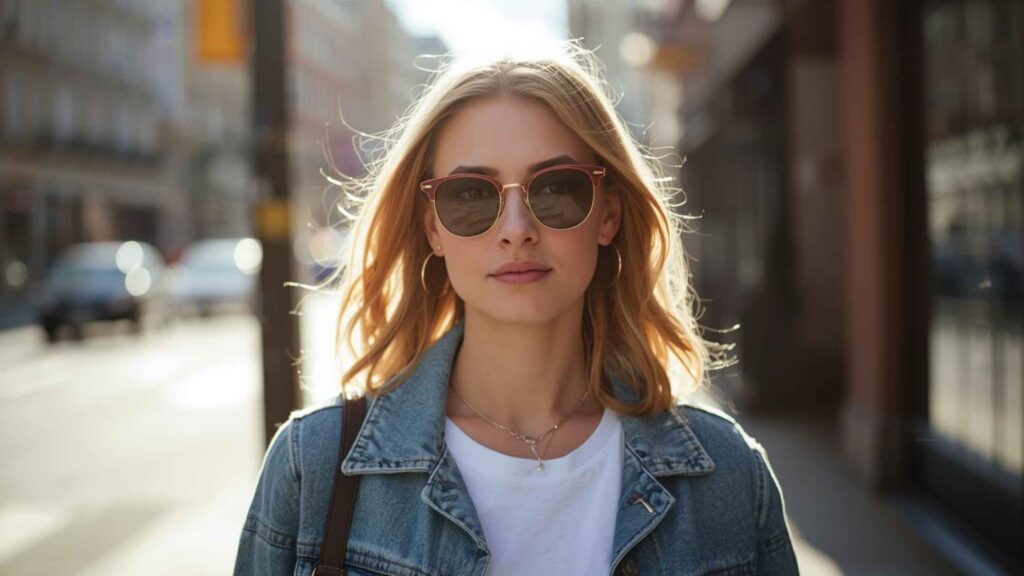
Sunset Boulevard, 1987 — Where It All Began?
The origin story of Oliver Peoples sunglasses is inseparable from the specific cultural geography of West Hollywood in the late 1980s. Larry Leight opened the first Oliver Peoples boutique on Sunset Boulevard in 1987 — a moment when the Sunset Strip was simultaneously the epicenter of hair metal excess and the neighborhood where Hollywood’s creative establishment quietly went about the business of making culture.
The boutique was unlike anything else operating in the eyewear market at the time. Rather than presenting a conventional optical retail environment, it was curated like a gallery — vintage frames displayed alongside new designs, the entire space communicating that eyewear was being taken seriously as a design discipline rather than treated as an accessory afterthought. The name itself came from a combination of Oliver — for its classic, slightly literary quality — and Peoples, for the democratic suggestion that great eyewear should be for everyone worth noticing.
The entertainment industry took note almost immediately. The proximity to the studios, the talent agencies, and the restaurants where Hollywood conducted its daily business meant that creative decision-makers discovered Oliver Peoples early. Costume designers found frames that worked for period productions and contemporary ones equally. Actors found frames that served their off-duty image without overwhelming it. Directors found frames that looked exactly right in photographs without ever looking like they were trying to.
This early Hollywood adoption wasn’t a marketing strategy — it was organic recognition between a brand that understood restraint and an industry that needed it. The relationship has never really changed.
The Quiet Luxury Philosophy — Why It Resonates in Hollywood?
LA luxury operates according to different rules than the luxury codes that govern New York finance or Paris fashion. Hollywood wealth has always been more comfortable with casual excellence than conspicuous consumption — the industry’s power players tend to dress with deliberate ease rather than formal display, favoring brands that communicate quality to those who know rather than logos that broadcast status to everyone.
Oliver Peoples was essentially built for this sensibility before the term “quiet luxury” existed to describe it. The brand’s design principles — restrained silhouettes, premium materials presented without excess, vintage-informed intelligence that doesn’t require fashion literacy to appreciate — align precisely with the way Hollywood’s creative class has always approached personal style.
Minimalist eyewear in the Oliver Peoples tradition doesn’t mean visually simple. The Gregory Peck’s perfectly calibrated round, the Sheldrake’s refined rectangle, the subtle depth of Mazzucchelli acetate in the brand’s proprietary colorways — these are objects of genuine visual complexity that reveal themselves slowly rather than immediately. That quality — the sense of discovering more the longer you look — is exactly what draws people who understand visual storytelling toward the brand.
The entertainment industry also understands that accessories in the public eye function differently than accessories in private life. A pair of Oliver Peoples frames in a paparazzi photograph doesn’t distract from the face wearing them. A pair of dramatically logo-forward luxury frames might. For public figures whose image management is a professional consideration, that distinction matters enormously.
Celebrity Oliver Peoples — The Frames That Built the Cultural Connection
The relationship between celebrity OP sunglasses and specific cultural moments deserves attention beyond simple name-dropping — because the way Oliver Peoples frames have appeared in public life illuminates something genuine about the brand’s design philosophy and its relationship with the people who choose it.
The Gregory Peck and Its Namesake Legacy
The Gregory Peck frame wasn’t named for the actor after he wore it — it was named in tribute to a specific kind of Hollywood masculinity that the frame’s design was meant to reference. The irony is that the frame subsequently became genuinely associated with the kind of quietly authoritative, intellectually distinguished creative personality that Peck himself embodied. When contemporary cultural figures whose work demands that their face be taken seriously — writers, directors, musicians who operate in the serious register — reach for a round frame, the Gregory Peck is frequently the specific object they reach for.
The Visual Shorthand of Understated Frames
Costume designers have used Oliver Peoples frames as visual shorthand for a specific kind of character — the intelligent insider, the person whose sophistication doesn’t need announcement — in productions ranging from prestige television dramas to independent films where visual authenticity matters more than brand recognition. When a character needs to read as genuinely cultured rather than merely wealthy, OP frames accomplish that in a single shot with no dialogue required.
Off-Duty Hollywood and the OP Default
The brand’s real celebrity relationship lives less in formal appearances and red carpets — where eyewear choices are typically more dramatically fashion-forward — and more in the off-duty photographs and candid moments where people whose work requires careful image management simply reach for what makes them feel most like themselves. The consistency with which creative industry professionals return to Oliver Peoples sunglasses in these unguarded moments is the most genuine measure of the brand’s place in Hollywood’s visual culture.
Signature Oliver Peoples Frames — The 2026 Collection
The Gregory Peck — Canonical Round Authority
The Gregory Peck remains the frame that most completely defines what Oliver Peoples is and believes. A medium round in premium acetate, available in the brand’s carefully developed proprietary colorways — Cocobolo, Dusty Black, the warm tortoiseshells that define the OP palette — this frame has been in continuous production since the brand’s early years and shows no signs of the relevance decline that afflicts most fashion-adjacent objects over similar timeframes.
The Gregory Peck works because it achieves a specific and difficult balance: it references vintage eyewear design deeply enough to carry genuine design authority, while maintaining proportions and construction standards that feel entirely contemporary. Wearing it doesn’t feel like wearing a costume or a period reference — it feels like wearing something that has always existed and has always been right.
In Oliver Peoples sunglasses 2026, the Gregory Peck continues to anchor the collection as the frame against which everything else is measured. New colorway introductions in the 2026 season — including subtle updates to the brand’s acetate palette that reflect the cooler, more muted tonal direction in contemporary luxury fashion — keep the frame current without disrupting the design stability that makes it canonical.
The Sheldrake — The Professional’s Frame
If the Gregory Peck is Oliver Peoples’ most beloved frame, the Sheldrake is its most useful one. A modified rectangle with softened corners and the kind of proportional balance that suits a genuinely wide range of face architectures, the Sheldrake has become the default choice for OP buyers whose wardrobes demand cross-context versatility above all else.
OP eyewear in the Sheldrake construction demonstrates particularly clearly the brand’s colorway sophistication — the same frame in Buff reads as warmly vintage and gently intellectual; in Black reads as precisely contemporary; in semi-matte dark tortoiseshell reads as quietly authoritative. The colorway is doing as much design work as the silhouette, which is the mark of a brand that understands its materials with genuine depth.
The Sheldrake’s Hollywood associations run through the costume design tradition rather than the celebrity photograph one — it’s the frame that appears on the right character at the right moment in prestige productions precisely because its visual register is versatile enough to serve multiple character types without defaulting to cliché.
The Cary Grant — Precision Masculine Elegance
Named for the actor whose personal style remains among the most analyzed and most admired in Hollywood history — whose wardrobe operated on the principle that elegance is the absence of effort rather than its excess — the Cary Grant frames bring a geometric precision to the OP catalog that complements the warmer, rounder sensibility of the Gregory Peck.
The slightly squared silhouette with refined corner treatment represents minimalist eyewear at its most architecturally committed — frames that carry their vintage reference in the proportions and the construction rather than in any overtly period-specific detail. In titanium constructions, the Cary Grant achieves a physical lightness that matches its aesthetic lightness — sitting on the face with authority that contradicts its negligible weight.
For the Hollywood buyer whose personal style leans toward the more constructed, more precisely engineered end of the LA luxury spectrum, the Cary Grant is the natural Oliver Peoples frame — a design that earns its name by embodying the same quality its namesake embodied: making the difficult look entirely easy.
The O’Malley — The Universal Round
The O’Malley occupies a specific and valuable position in the Oliver Peoples frames catalog — a round frame with more structural definition and design intentionality than the Gregory Peck’s warmer vintage sensibility, but without the geometric precision that places the Cary Grant in more overtly architectural territory.
The O’Malley’s keyhole bridge and slightly more defined acetate temple construction give it a character that reads as both vintage-informed and contemporary — a frame that works as naturally on a film director in a casting session as on a musician in a festival photograph. This cross-context versatility, combined with genuine unisex wearability, makes the O’Malley one of the most consistently recommended celebrity OP sunglasses for buyers who want a single frame that moves across every context without friction.
The Finley Vintage — Summer Authority
The Finley Vintage is Oliver Peoples’ most explicitly sun-specific statement — a keyhole bridge construction with a more substantial frame face and lens depth that creates genuine outdoor presence while maintaining the brand’s characteristic design restraint. The frame photographs particularly well — the combination of architectural bridge detail and warm acetate colorways creates a visual richness that rewards camera proximity rather than merely tolerating it.
For Oliver Peoples sunglasses 2026, the Finley Vintage has been updated with new colorway introductions that expand its seasonal range — lighter, more transparent acetate options that carry the frame’s design authority into warmer weather contexts with particular success. The California light that informed the brand’s original design sensibility is most directly expressed in the Finley Vintage, making it the frame that feels most specifically and most authentically LA in the entire collection.
The Romare — Contemporary Direction
The Romare represents the 2026 collection’s most direct engagement with contemporary luxury design direction — wider proportions, more architectural geometry, and a design intention that reflects the current premium fashion aesthetic without abandoning the material standards and design restraint that define Oliver Peoples.
For buyers approaching OP eyewear for the first time through the lens of contemporary minimalist luxury fashion — the tonal, proportion-focused, quality-over-branding aesthetic that has defined luxury casual dressing across the past several seasons — the Romare offers the most natural entry point. It speaks the current design language while carrying it in Oliver Peoples’ specific material voice.
Oliver Peoples and Film — A Production Design Relationship
The connection between Oliver Peoples sunglasses and the film industry runs deeper than celebrity endorsement — it extends into the specific relationship between the brand and the production design and costume design disciplines that shape how characters are visually constructed on screen.
Oliver Peoples has provided frames for productions across the full spectrum of prestige filmmaking — from period pieces requiring vintage-accurate optical details to contemporary dramas where the specificity of a character’s eyewear signals cultural and class positioning with precision. The brand’s vintage-archive depth makes it particularly valuable for period productions, while the contemporary collection’s design restraint makes it equally useful for modern characters who need to read as sophisticated without the eyewear becoming a recognizable brand moment.
This production design relationship is itself a reflection of the brand’s design philosophy. Oliver Peoples frames work in film because they serve the face wearing them rather than competing with it — they become part of a character rather than an accessory on top of one. That quality, which is the result of deliberate design choices across four decades of brand development, is exactly what makes them equally effective in real-world daily wear.
The LA Aesthetic — How Geography Shapes Design?
LA luxury has a specific quality that distinguishes it from the luxury codes of every other global fashion capital — and Oliver Peoples sunglasses are its most concentrated expression in eyewear form.
Los Angeles luxury doesn’t aspire to European formality. It doesn’t perform wealth through the visual codes that Paris and Milan have spent centuries developing. Instead, it communicates quality through the effortlessness of its wearing — the sense that the person in a perfectly fitted cashmere T-shirt, quality denim, and a pair of Oliver Peoples rounds is dressed exactly as much as the situation warrants and not a single element more.
This aesthetic sensibility — which the fashion world has spent the past decade catching up to under the “quiet luxury” designation — was always the operating principle in West Hollywood’s creative community. Oliver Peoples didn’t invent it; the brand grew from it, reflected it back to the people who already lived it, and built a design language precise enough to carry it into a global market that turned out to be hungry for exactly what LA’s creative class had been wearing all along.
The brand’s colorway development reflects this geography directly. The warm neutrals, the honey-amber tortoiseshells, the particular quality of Cocobolo brown — these are colors that look right in California light in a way that’s difficult to fully articulate but immediately apparent to anyone who has spent time in that specific quality of late-afternoon sun. Oliver Peoples frames look like they were designed outdoors, which is because, in the most important sense, they were.
Oliver Peoples Sunglasses 2026 — Where the Brand Stands?
The Oliver Peoples sunglasses 2026 catalog reflects a brand that has achieved something genuinely rare in luxury fashion — design maturity without stagnation. The core frames that built the brand’s reputation are maintained with the consistency that canonical designs deserve, while new silhouettes and colorway developments keep the collection current without disrupting the aesthetic coherence that makes Oliver Peoples worth choosing in the first place.
The brand’s continued collaboration with Brunello Cucinelli — the Italian luxury house whose craft-first, slow-fashion philosophy aligns almost perfectly with OP’s own design values — has produced the 2026 season’s most refined limited pieces. The collaboration frames carry both brands’ characteristic restraint within a material quality that reflects genuine joint investment in what premium eyewear should be.
Pricing across the OP eyewear core collection remains in the $350–$550 USD range — a price point that, given the material quality, Japanese manufacturing standards, and design intelligence delivered, represents honest value in a market where luxury pricing frequently outpaces luxury substance.
Styling Oliver Peoples — The Hollywood Way
Oliver Peoples frames carry their design authority most naturally when worn with the same quality of deliberate ease that defines their design philosophy. The goal is never to look dressed up — it’s to look completely like yourself, only more precisely realized.
For the LA luxury wardrobe — quality basics, considered casual pieces, the kind of clothing that looks simple and costs significantly — Oliver Peoples rounds and rectangles function as the final element that makes a simple composition complete. A Gregory Peck in Cocobolo over a quality white shirt and dark denim is one of the most consistently successful casual luxury combinations available, precisely because every element is doing exactly as much work as it needs to and no more.
For professional and business contexts, the Sheldrake and Cary Grant models carry enough geometric authority to suit structured environments without the eyewear becoming a conversation piece. The frames say “considered” rather than “fashion-forward” — which is exactly the right register for contexts where your ideas should be the most interesting thing about you.
For occasions where slightly more personality is appropriate — weekend dressing, cultural events, the relaxed social contexts where Hollywood’s creative class operates most naturally — the Finley Vintage and O’Malley offer the brand’s warmest, most characterful expressions of minimalist eyewear authority.

FAQ — Oliver Peoples Sunglasses
Why are Oliver Peoples sunglasses popular with celebrities?
Oliver Peoples sunglasses appeal to celebrities because their design restraint serves rather than competes with the wearer’s face — a critical consideration for public figures whose image management is a professional responsibility. The brand’s minimalist eyewear philosophy, premium material quality, and vintage-informed design intelligence communicate sophistication to those who know without broadcasting logos to those who don’t.
What are the best Oliver Peoples sunglasses for 2026?
The strongest Oliver Peoples sunglasses 2026 pieces include the Gregory Peck for canonical round authority, the Sheldrake for cross-context rectangular versatility, the Cary Grant for precise masculine elegance, the O’Malley for genuine unisex wearability, and the Finley Vintage for sun-specific California warmth. Each represents the brand’s design philosophy at a different point on the versatility-to-character spectrum.
Are Oliver Peoples frames worth the investment?
Oliver Peoples frames justify their $350–$550 USD pricing through premium Mazzucchelli acetate in proprietary colorways, Japanese manufacturing standards, vintage-informed design intelligence that produces genuinely timeless silhouettes, and the kind of consistent brand vision that ensures frames purchased today will look as considered in a decade as they do now. For buyers who value design integrity over logo visibility, the investment is fully justified.
What makes Oliver Peoples different from other luxury eyewear?
OP eyewear is distinguished by its specific combination of Hollywood creative heritage, vintage design intelligence, and the LA luxury aesthetic philosophy that prioritizes effortless quality over conspicuous branding. The brand occupies a unique position — genuinely premium in material and construction, genuinely restrained in design and branding, and genuinely rooted in a specific cultural geography that gives its aesthetic language a depth and coherence that purely commercially-driven luxury brands rarely achieve.
Do Oliver Peoples sunglasses suit all face shapes?
The brand’s range accommodates most face architectures with genuine consideration. Round frames — the Gregory Peck, O’Malley — work best on angular, square, and oval faces. Rectangular frames — the Sheldrake, Romare — suit oval, round, and heart-shaped faces most naturally. The Cary Grant’s modified square suits oval and oblong face structures with particular elegance. The brand’s range is broad enough that most buyers will find multiple frames that suit their specific face architecture rather than a single accommodating option.
The Frame That Lets You Be Seen
Oliver Peoples sunglasses have spent nearly four decades building the same argument with remarkable consistency — that the most intelligent luxury accessory is the one that serves the person wearing it rather than demanding attention for itself. That the frame should make the face more interesting, not less. That restraint, executed with genuine craft intelligence, is not a limitation but the most demanding and most rewarding form of design ambition.
Hollywood understood this intuitively before the broader luxury market caught up. The entertainment industry’s most visually sophisticated personalities — the ones who understand that image is constructed through accumulation of precise details rather than single dramatic gestures — found in Oliver Peoples a brand that shared their understanding of how this works.
In 2026, that understanding is more broadly shared than ever. The quiet luxury conversation that has defined premium fashion’s cultural direction for the past several seasons is, in many ways, finally arriving at the place where OP eyewear has always been — the conviction that the most powerful thing you can wear is the thing that makes you look most completely and most unapologetically like yourself.
Found your Oliver Peoples frame? Share this guide with someone building a considered luxury wardrobe — or explore our complete breakdown of the most intelligently crafted minimalist eyewear worth wearing in 2026.




 Brush
Brush Makeup Mirrors
 Body Lotions & Body Oils

 Personal Scales
 Perfume Coffrets
 Perfume Testers
 All Eyewear
 Unisex
 Optical
 Contact Lenses
 Home Fixtures
 Dining & Bar