


Latest posts
Gucci vs Cartier Sunglasses: The Ultimate Luxury Duel

Walk into a department store and you’ll find Gucci and Cartier sharing shelf space, sharing clientele, and sharing a tier of the market that most brands can only aspire to. From a distance, the comparison feels obvious — two storied European houses, both with century-long histories, both producing sunglasses that cost more than some people spend on a month’s rent. But the closer you look, the more clearly these two brands diverge.
Table of Contents
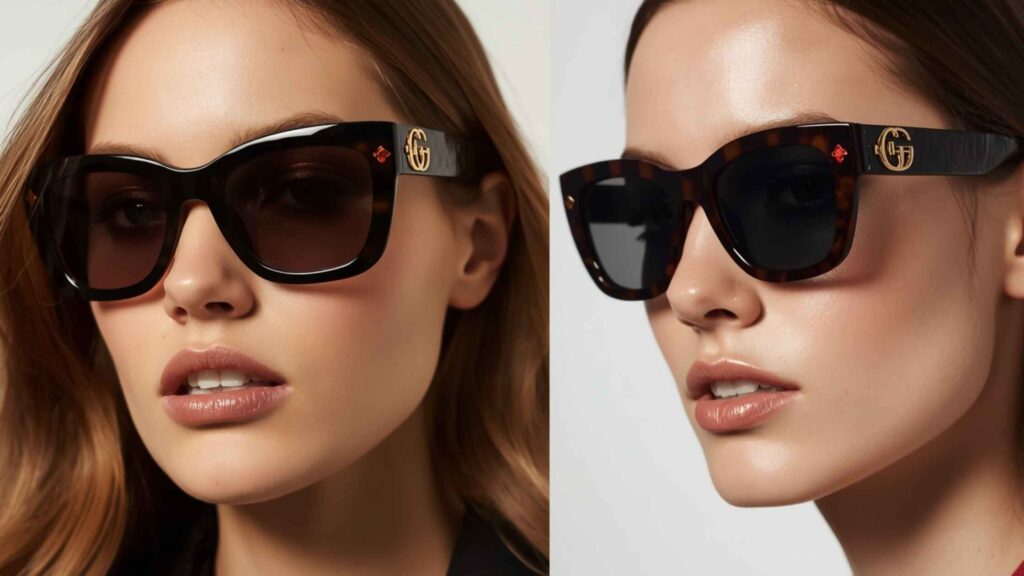
Gucci vs Cartier sunglasses is ultimately a comparison between two different theories of what luxury means. One house built its modern identity on bold, maximalist self-expression and the deliberate collision of high fashion with street-level energy. The other has operated for over 170 years on a single, unwavering proposition: that the finest materials, handled with the greatest restraint, produce objects of permanent value. Getting the comparison right requires understanding what each house is actually selling — and whether that’s what you actually want to buy.
Gucci
- Founded 1921, Florence
- DNA Fashion-forward, expressive
- Key materials Acetate, nylon, metal
- Price range$250 – $700+
- Parent group Kering
- Eyewear partner Kering Eyewear
Cartier
- Founded 1847, Paris
- DNA Timeless, jeweller’s precision
- Key material Gold, platinum, premium acetate
- Price range$500 – $5,000+
- Parent group Richemont
- Eyewear approachIn-house fine jewellery standards
Gucci vs Cartier Sunglasses: Style Philosophy
Gucci — fashion as identity statement
Gucci’s modern eyewear identity was forged under Tom Ford in the late 1990s and cemented by Alessandro Michele’s maximalist tenure from 2015 to 2022. The house learned that its customer doesn’t come to Gucci for understatement. They come for the double-G hardware, the archive-referencing print acetates, the retro-inflected oversized silhouettes that make wearing sunglasses feel like a declarative act rather than a practical one.
That philosophy produces some genuinely excellent frames. The Gucci GG0396S, with its interlocking logo temples, has been widely imitated because the design logic behind it is sound — a recognizable brand marker executed in a silhouette that flatters a wide range of face shapes. The acetate colorways Gucci deploys, often referencing archive prints or house motifs, show a design team that understands how to translate fashion heritage into wearable product. When it works, Gucci eyewear feels like a complete extension of a personal aesthetic.
The trade-off is consistency. Gucci’s eyewear quality varies across its range more than Cartier’s does. Entry-level pieces in the $250–$350 bracket share a brand name with frames costing twice that, but the material and construction quality difference between them is meaningful. A buyer investing at the higher end of Gucci’s eyewear range gets a significantly better object than one buying at the floor.
Cartier — jeweller’s restraint applied to eyewear
Cartier’s entry into eyewear, beginning in earnest in the 1980s with the Santos line, was never a fashion play. It was an extension of the jewellery house’s core value proposition: that gold, platinum, and the most precisely finished metals produce objects of enduring worth. The signature Cartier sunglasses — the Panthère, the Santos-Dumont, the C Décor — share an aesthetic logic with Cartier’s watches and bracelets. They are calm, architecturally precise, and designed to read as valuable without needing to announce it.
The Santos frame in particular has become one of the most recognizable pieces of luxury eyewear produced in the last forty years, and its resilience in the market reflects genuine design intelligence. The screwed detail at the corners, the integration of the bridge into the front bar, the proportional relationship between the lens and the temple — these are decisions made by people who think carefully about objects. The result is a frame that doesn’t look like it was made to a trend cycle. It looks like it was made to last several decades and succeed at it.
“Gucci wants you to be seen wearing their frames. Cartier wants the frames themselves to be seen — and the distinction in that sentence is the entire brand difference.”
Frame Materials and Build Quality: The Luxury Eyewear Comparison That Matters Most
In any serious luxury eyewear comparison, materials and construction are where brand positioning meets physical reality. Marketing language is easy; what a frame actually feels like in your hands after two years of daily wear is harder to fake.
Acetate quality
Gucci — Italian Mazzucchelli acetate on higher-tier frames; good polish and color depth.
Cartier — premium acetate where used; most signature frames prioritize metal.
Metal construction
Gucci — gold-toned alloys, well-finished but not precious metal.
Cartier — actual gold plating (18k on high-end lines); jeweller-standard finishing.
Hinge engineering
Gucci — solid spring hinges at upper price points; adequate for the segment.
Cartier — precision barrel hinges; noticeably tighter tolerances and smoother action.
Lens options
Gucci — standard UV400; polarized available on select models.
Cartier — high-clarity mineral glass on premium lines; superior optical precision.
The material gap between these two houses widens significantly at the top of their respective ranges. A Gucci frame at $500 is a well-made fashion accessory with genuine brand DNA. A Cartier frame at $1,200 — the Panthère or the Santos in gold — crosses into fine jewellery territory in terms of the material standards applied. Cartier’s relationship with precious metals isn’t cosmetic. The house finishes its frames with the same standards it applies to its bracelets, which means the gold plating is thicker, more evenly applied, and more resistant to the wear patterns that erode cheaper finishes within eighteen months.
That said, Gucci’s acetate frames at $400–$600 represent genuinely strong value within the luxury segment. Italian acetate handled well produces frames that feel substantial, age gracefully, and hold color in a way that cheaper alternatives do not. If acetate is the frame material you prefer, Gucci at its mid-to-upper range competes respectably with what Cartier offers.

Pricing and the Audience Each Brand Actually Serves
Who buys Gucci eyewear?
Gucci’s eyewear customer is fashion-conscious in a way that intersects with, but doesn’t require, a background in luxury goods. The brand’s accessibility relative to Cartier — entry-level frames starting around $250, with most core styles in the $300–$550 range — means that Gucci sunglasses function as both a genuine luxury purchase and a first-step introduction to the luxury market. For a buyer in their twenties or thirties who wants the cultural legibility of a recognizable house at a price point that doesn’t require significant deliberation, Gucci delivers efficient luxury signalling.
The brand also performs strongly with buyers who rotate through eyewear with seasonal wardrobes. Because Gucci releases new colorways and silhouettes regularly, and because the design language is tied to fashion cycles, a Gucci customer who approaches eyewear as a fashion category rather than an investment category is well served. The frames don’t need to last ten years if you’re replacing them every two.
Who buys Cartier eyewear?
Cartier’s eyewear buyer typically has a different relationship with luxury objects. They tend to be older on average, more likely to approach a frame purchase the way they’d approach a watch purchase — as something that will be worn daily for years, that should hold its value, and that should read as elegant rather than fashionable across different contexts. Cartier sunglasses are corporate lunch and first-class cabin appropriate in a way that a logo-forward Gucci frame sometimes isn’t.
The higher price floor — meaningful Cartier eyewear starts around $500, with the most desirable pieces running $800 to $2,500 and beyond — filters the brand’s audience toward buyers who understand what they’re paying for and are buying deliberately rather than impulsively. That buyer profile is not better or worse than Gucci’s; it’s different. The consideration set is longer, the resale market is stronger, and the frame is more likely to be kept, maintained, and handed down.
Which Is Better — Gucci or Cartier? The Balanced Verdict
For anyone asking which is better, Gucci or Cartier, the most useful answer is also the most honest one: it depends entirely on what you mean by better. These brands are not competing in the same category despite occupying adjacent shelf space.
Choose Gucci if you want
Fashion-forward design that changes with the seasons. Strong brand recognition across age groups. Access to the luxury tier at a more approachable price. Acetate quality that punches above its weight in the mid-range.
Choose Cartier if you want
Frames that function as fine jewellery. Design built to outlast trends by decades. Precious-metal construction standards that justify the price premium. A resale market that treats the frames as collectible objects.
On the specific question of luxury eyewear brands compared for long-term value, Cartier has the stronger case. The Santos and Panthère frames have held collector interest for forty years, and the precious metal construction means that a well-maintained Cartier frame depreciates more slowly than almost any comparable product in the eyewear category. If you are buying one pair of sunglasses and intend to wear them for a decade, Cartier is the more rational choice on a cost-per-wear analysis.
But rational analysis isn’t always the right frame for a luxury purchase. If what you want is a frame that fits a fashion-forward wardrobe, that your stylist or your peer group will recognize as current, and that you can acquire without spending four figures — Gucci serves that need better than Cartier does. Neither answer is a concession.
Frequently Asked Questions
Do Cartier sunglasses hold their resale value better than Gucci?
Generally, yes — particularly on the signature metal frames like the Santos and Panthère. Cartier’s precious-metal construction, strong secondary market demand, and design stability mean that well-maintained frames retain value more consistently. Gucci’s resale market is more volatile because the brand’s eyewear design changes with fashion cycles, making older styles depreciate faster.
Are Gucci sunglasses considered real luxury eyewear?
Yes, unambiguously — Gucci is one of the most recognized luxury fashion houses in the world, and its eyewear at the mid-to-upper range uses genuine quality materials. The distinction worth making is between fashion luxury and fine jewellery luxury. Gucci operates in the fashion category; Cartier operates closer to the fine jewellery standard. Both are real luxury, but they are different kinds of luxury.
Which brand is more versatile — Gucci or Cartier?
Cartier frames tend to be more universally versatile because their design restraint makes them appropriate across a wider range of contexts — formal, casual, professional. Gucci’s more expressive silhouettes and logo details are highly versatile within fashion-forward environments but can read as over-designed in conservative professional settings. The right answer depends on the contexts you spend most of your time in.
What is the price difference between Gucci and Cartier sunglasses?
Gucci’s core eyewear range runs from approximately $250 to $700, with most popular styles in the $300–$550 band. Cartier’s meaningful entry point is around $500, with flagship metal frames running $800 to $2,500 and limited or precious-metal pieces going considerably higher. The brands share some price overlap in the $500–$700 range, but Cartier’s ceiling is substantially higher.
Can you spot a fake Gucci or Cartier frame easily?
Both brands are heavily counterfeited, and sophisticated fakes have become harder to identify by sight alone. The most reliable authentication markers for Gucci are the engraving depth and consistency on the hardware and the acetate polish quality. For Cartier, the hinge action, the gold-plating thickness, and the precision of the screwed corner details are the most telling tells. When in doubt, buy from authorized retailers or with authentication documentation.
The Gucci vs Cartier sunglasses debate doesn’t resolve to a winner — it resolves to a clearer understanding of your own priorities. Gucci is the choice of a buyer who wants fashion and brand energy at an accessible luxury price. Cartier is the choice of a buyer who wants permanence, material prestige, and the quiet confidence that comes from wearing something built to the standards of a jewellery house. Both are excellent reasons to spend money on sunglasses.

 Brush
Brush Makeup Mirrors
 Body Lotions & Body Oils

 Personal Scales
 Perfume Coffrets
 Perfume Testers
 All Eyewear
 Unisex
 Optical
 Contact Lenses
 Home Fixtures
 Dining & Bar