


Latest posts
Prada vs Miu Miu vs Tom Ford Sunglasses — The Style Breakdown

Some decisions are genuinely difficult. Choosing between three of the most distinct luxury eyewear labels on the market — each with a coherent aesthetic identity, a loyal following, and real quality behind the price tag — is one of them. Prada vs Miu Miu vs Tom Ford sunglasses isn’t a comparison with an obvious winner. It’s a comparison that resolves differently depending on who you are, how you dress, and what you actually want a pair of sunglasses to do for you.
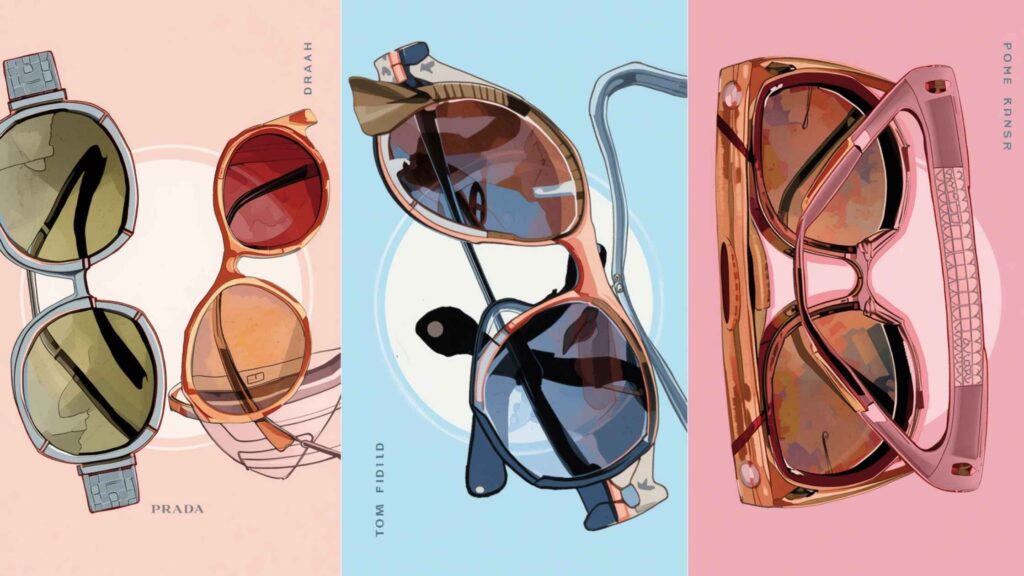
What makes this particular three-way interesting is that each brand represents a genuinely different theory of what designer frames should be. Prada operates from a place of intellectual cool — considered, architectural, occasionally strange in the best possible way. Miu Miu, Prada’s younger sister label, takes that same foundation and pulls it toward something more overtly feminine, more playful, more willing to lead with charm rather than rigor. Tom Ford builds from a completely different starting point: the idea that luxury eyewear should be unambiguously glamorous, immediately legible as expensive, and designed to flatter the human face above all other considerations. Three brands. Three philosophies. One guide to help you choose.
Table of Contents
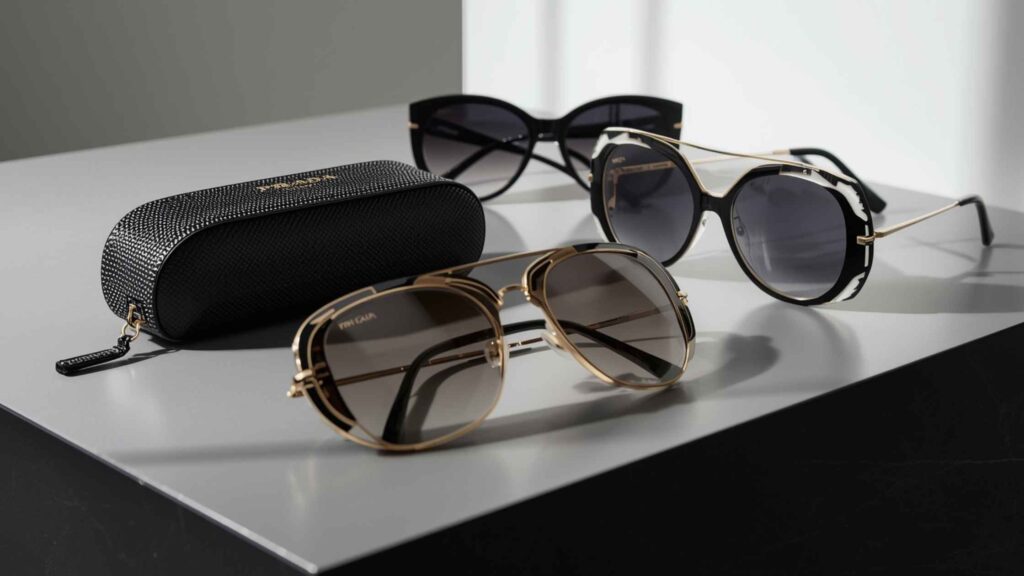
Prada vs Miu Miu vs Tom Ford Sunglasses: Understanding the Brand DNA First
Before getting into specific frames and price points, the most useful thing this luxury eyewear guide can do is establish what each brand is actually about at its core — because buying the wrong brand for your aesthetic is a more expensive mistake than buying the wrong frame from the right one.
Prada was founded in Milan in 1913 as a leather goods house and didn’t move meaningfully into fashion until Miuccia Prada took creative control in 1978. What she built over the following four decades is one of fashion’s most distinctive intellectual identities — a house that consistently uses ugliness, irony, and conceptual provocation as design tools alongside conventional beauty. A Prada frame is never merely pretty. It is always making an argument about what pretty means, and the argument is usually more interesting than the conclusion.
Miu Miu was created by Miuccia Prada in 1993 as a vehicle for a different side of her design imagination — one less interested in deconstruction and more interested in girlhood, whimsy, and the kind of femininity that doesn’t apologize for itself. The brand shares Prada’s manufacturing infrastructure and much of its material quality, but its emotional register is entirely different. Where Prada is cool, Miu Miu is warm. Where Prada challenges, Miu Miu invites.
Tom Ford is the brand as auteur project. Ford left Gucci in 2004 after transforming it from a struggling label into one of the most commercially successful fashion houses of the 1990s, and launched his eponymous brand in 2005 with a clear and unwavering aesthetic: old Hollywood glamour reinterpreted through a contemporary lens, with an unapologetic emphasis on sexiness, polish, and the kind of elegance that doesn’t require explanation. Tom Ford eyewear — produced in collaboration with Marcolin, one of Italy’s finest eyewear manufacturers — carries that vision with complete fidelity.
Design Philosophy: Where Each Brand Lives in Your Wardrobe
Prada — Intellectual Cool With an Edge
Prada sunglasses have a peculiar quality that sets them apart from most luxury eyewear: they look best on people who dress with intention. This isn’t a brand that flatters every wardrobe by default. The geometric frames, the architectural bridges, the deliberately off-proportion silhouettes that Prada deploys season after season — these are design decisions that reward an outfit built around them rather than frames dropped onto an existing look.
The 2026 collection continues Miuccia’s long-running interest in the tension between utilitarian function and high fashion. The Prada Symbole frames — defined by their upswept geometric lens and the Prada triangle logo hardware at the temples — are the clearest expression of that sensibility currently in production. They are immediately recognizable as Prada, immediately recognizable as 2026 , and entirely uninterested in being conventionally flattering to faces that don’t meet them halfway.
The brand’s strongest frames for daily wearability remain the Prada Linea Rossa and classic pilot silhouettes, where the house’s restraint produces something closer to a considered wardrobe staple than a fashion statement. These are the frames for the Prada customer who wants the brand’s intelligence without the full volume of its runway pieces.
Miu Miu — Playful Femininity as High Art
Miu Miu eyewear in 2026 is having a cultural moment that goes beyond the brand’s usual strong performance. The label’s emergence as the defining aesthetic reference for a generation of fashion-conscious women in their twenties and thirties has driven the eyewear into a visibility it hasn’t previously enjoyed — and the frames themselves have risen to meet the moment.
The Miu Miu Glimpse frames, with their cut-out lens detail and delicate metal hardware, represent the brand at its most photographically compelling. They are the kind of frames that appear in every editorial shot of the season not because a stylist chose them but because they photograph with an energy that more restrained alternatives don’t. The cat-eye silhouettes that run through the 2026 collection update a classic shape with Miu Miu’s particular brand of studied naivety — the proportions are slightly wrong in a way that looks completely right, the hardware details are more delicate than expected, the acetate colors include tones that shouldn’t work and do.
What distinguishes Miu Miu sunglasses from Prada isn’t merely aesthetic lightness. It’s a different relationship between the wearer and the frame. Prada frames wear the person as much as the person wears the frame. Miu Miu frames feel chosen, personal, slightly unexpected — the kind of accessory that makes people ask where you got them rather than immediately recognizing the brand.
Tom Ford — Glamour as Design Discipline
Tom Ford sunglasses operate from a simpler but harder-to-execute premise than either Prada or Miu Miu: make the wearer look as good as possible. Ford’s design team approaches each frame as a face-flattering instrument first and a fashion object second, which produces eyewear with a commercial confidence that the more conceptually oriented houses sometimes sacrifice in pursuit of originality.
The results, at their best, are extraordinary. The Snowdon pilot — one of Ford’s longest-running and most replicated styles — has stayed in production because it solves the proportional problem of a large-lens aviator better than almost anything else in the market. The FT1002 Chloe oversized round frames flatten light across the face in a way that feels almost cinematic. The Eunice shield, introduced more recently, demonstrates that Ford’s team can push into fashion-forward territory without losing the brand’s core commitment to wearability.
The glamour is real. What Ford understood better than most designers is that glamour isn’t decoration — it’s engineering. Making someone look more beautiful through the frame they’re wearing requires the same kind of precise calculation that making a beautiful frame requires. Tom Ford eyewear does both simultaneously, which is rarer than it sounds.
Material Quality and Manufacturing: The Honest Comparison
In any serious multi-brand comparison at this price level, materials and manufacturing deserve direct treatment rather than marketing language.
All three brands benefit from Italian manufacturing traditions, but through different routes. Prada and Miu Miu eyewear is produced through Luxottica — the same manufacturing group behind Ray-Ban, Versace, and several other major labels. Luxottica’s production standards are genuinely high, and the acetate and metal hardware quality across Prada and Miu Miu’s mid-to-upper range reflects that. The frames use Italian acetate with strong color depth and finish quality, and the metal hardware — temples, bridges, hinges — is finished to a standard appropriate for the price point.
Tom Ford produces through Marcolin, a family-owned Italian eyewear manufacturer based in Longarone with a long history of working with demanding luxury clients. Marcolin’s production tends to produce slightly heavier, more robustly finished frames than Luxottica’s mid-range output — a quality that Tom Ford customers frequently notice without always being able to articulate why the frames feel different in hand. The hinge engineering on Tom Ford’s upper-tier pieces is particularly strong, with a spring mechanism that has a damped, precise action that telegraphs quality immediately.
Lens quality across all three brands defaults to UV400 protection with good optical clarity. Polarized options are available selectively across each range. None of the three competes with Cartier’s mineral glass precision at the top of the market, but all three deliver optically clean lenses appropriate for luxury-tier pricing.
Pricing Across All Three Brands: What Each Level Gets You
Understanding the price architecture of each brand prevents the most common purchasing mistake in luxury eyewear — buying at the wrong tier of the range and drawing conclusions about the brand that don’t apply to its better frames.
Prada ranges from approximately $280 at the entry level to $650+ for statement and archive pieces. The quality inflection happens around $380–$420, where the acetate thickness, hardware finishing, and hinge quality all improve meaningfully. Below that threshold, you’re paying primarily for the triangle logo. Above it, you’re paying for a genuinely well-made Italian frame.
Miu Miu sits in a similar range — $250 to $550 for most of the core collection, with limited and embellished pieces going higher. The brand’s sweet spot is $300–$450, where the delicate hardware details and acetate colorways that define the Miu Miu aesthetic are best expressed. At the entry level, the frames can feel slightly light in the hand; at the mid-range and above, the quality is entirely appropriate.
Tom Ford commands a premium across its range relative to both Prada and Miu Miu — entry frames begin around $350, with the core collection running $400–$600 and limited or special material pieces exceeding $700. That premium is partly Marcolin’s manufacturing quality, partly the brand’s particular position as a celebrity-adjacent luxury label, and partly the engineering confidence of the designs themselves. For buyers who prioritize wearability and face-flattering construction over conceptual design, the premium is justifiable.
Best Luxury Sunglasses 2026: Which Brand Wins for Each Buyer
The question driving most searches for a best luxury sunglasses 2026 review isn’t which brand is objectively superior — it’s which brand is right for a specific person with a specific wardrobe and a specific sense of self. Here is where the three-way comparison produces its most useful answers.
Choose Prada if your wardrobe is built around clean, architectural pieces — structured coats, minimal knitwear, tailoring with interesting proportion. If you follow fashion at the level of reading collections rather than just buying results. If you want frames that communicate something about how you think, not just how you look. If you’re comfortable in something slightly challenging rather than immediately flattering.
Choose Miu Miu if your aesthetic runs feminine, layered, or vintage-inflected — if you collect interesting vintage pieces alongside contemporary fashion, if you respond to accessories that feel found rather than bought, if you want a frame that gets noticed and commented on rather than simply recognized as a luxury brand. Miu Miu in 2026 is also the strongest of the three for buyers who follow social media fashion culture and want frames that photograph with the energy of what’s currently moving.
Choose Tom Ford if you prioritize looking your best over looking your most interesting. If your wardrobe is polished, occasion-conscious, and built around pieces that perform across different contexts — dinners, travel, professional settings that allow personality. If you want frames that work as hard on your face as they do on a hanger. Tom Ford is also the strongest of the three for buyers who are newer to the luxury eyewear category and want the security of knowing their investment is designed to flatter.
Choosing Eyewear Brand Guide: The Questions That Decide It
The most practical choosing eyewear brand guide doesn’t come from a list of specifications — it comes from the right questions asked in the right order.
The first question is wardrobe, not brand. What do you actually wear, on an average Tuesday rather than in your best-outfit imagination of yourself? Prada rewards a wardrobe built on considered basics and interesting silhouettes. Miu Miu rewards a wardrobe that already has personality and wants the accessories to match it. Tom Ford rewards a wardrobe where quality and occasion-appropriateness are the primary organizing principles.
The second question is longevity. Are you buying one frame to wear for five years, or are you the kind of buyer who rotates eyewear seasonally? If it’s the former, Tom Ford’s timeless glamour and Prada’s classic-facing styles hold their relevance longest. If you rotate, Miu Miu’s fashion-forward energy is more appropriate — the brand’s alignment with current cultural moments means its frames feel right now in a way that depreciates at a faster rate, but for the buyer who will replace them in two years that’s a feature rather than a flaw.
The third question is face shape and flattery. Tom Ford is the strongest performer here across the broadest range of face types. Prada’s geometric and oversized silhouettes favor oval and longer face shapes. Miu Miu’s cat-eye emphasis tends to suit higher cheekbones and heart-shaped or oval faces, though the range is wide enough to accommodate more variety.
Frequently Asked Questions
Which brand has the best resale value — Prada, Miu Miu, or Tom Ford?
Prada holds resale value most consistently of the three, partly due to its longer heritage and the stronger secondary market for its classic styles. Tom Ford performs well on limited and celebrity-adjacent pieces. Miu Miu’s resale market is more volatile because its frames are more trend-tied — high demand immediately after cultural moments, faster depreciation afterward.
Are Miu Miu sunglasses the same quality as Prada?
They share manufacturing infrastructure through Luxottica and Italian acetate sourcing, so the base material quality is comparable at equivalent price points. The design and aesthetic identity are meaningfully different, but a Miu Miu frame at $380 is built to broadly the same standard as a Prada frame at $380. The quality difference most buyers perceive between them reflects design sensibility, not manufacturing grade.
Is Tom Ford eyewear worth the price premium over Prada?
For buyers who prioritize face-flattering design and robust hinge construction, yes — Marcolin’s manufacturing produces a slightly more substantive physical object than Luxottica’s equivalent tier, and the design investment in wearability is genuine. For buyers who prioritize conceptual design and fashion credibility, Prada delivers more of what they’re looking for at a lower price point.
Which brand is better for men’s luxury eyewear in 2026?
Tom Ford has the strongest and most developed men’s range — the Snowdon, the James, and the newer geometric metal styles are among the best men’s luxury frames currently in production. Prada offers strong men’s options particularly in the Linea Rossa athletic-luxury range. Miu Miu is primarily women’s focused, though its more architectural pieces cross over effectively for buyers comfortable with that aesthetic.
Can I wear any of these brands in professional settings?
Tom Ford most comfortably crosses into conservative professional environments — the glamour reads as polished rather than fashion-forward in most contexts. Prada’s classic and pilot styles work professionally; the more architectural pieces are better suited to creative industries. Miu Miu’s most expressive cat-eye and embellished styles skew creative-professional or social rather than formally corporate.
The answer to Prada vs Miu Miu vs Tom Ford sunglasses was never going to be a single name. It was always going to be a question answered by the mirror — by what you’re already wearing, what you already value, and what you want a pair of sunglasses to say when you walk into a room. Prada says you think carefully about things. Miu Miu says you feel carefully about things. Tom Ford says you’ve arrived, you know it, and you’d like the room to agree. All three are correct positions to occupy. The only wrong answer is buying the wrong one for who you actually are.
Which of the three speaks to your wardrobe? Share your take in the comments — or tell us which frame you’re deciding between and we’ll help you land it.




 Brush
Brush Makeup Mirrors
 Body Lotions & Body Oils

 Personal Scales
 Perfume Coffrets
 Perfume Testers
 All Eyewear
 Unisex
 Optical
 Contact Lenses
 Home Fixtures
 Dining & Bar