


Latest posts
Tom Ford vs Versace Sunglasses — Which Luxury House Fits Your Style?

Some comparisons are close. This one isn’t — at least not in the conventional sense. Tom Ford vs Versace sunglasses doesn’t pit two similar houses against each other and ask which executes the shared vision better. It places two genuinely different visions of bold luxury in direct conversation and asks which one belongs to you. Both are loud. Both are confident. Both produce eyewear that makes an unambiguous statement before the wearer has opened their mouth. But the statement each makes, and the personality each requires of the person making it, are different in ways that matter for anyone trying to understand which frame actually belongs on their face.
Tom Ford’s boldness is cinematic — controlled, deliberate, and constructed with the precision of someone who spent a decade at Gucci learning how to make fashion feel like the most powerful version of a specific fantasy. Versace’s boldness is operatic — abundant, mythology-referencing, and built on the conviction that excess, deployed with genuine design intelligence, is not a limitation but a form of artistic freedom that most houses are too cautious to fully embrace.
This men and women eyewear comparison maps both houses honestly across every dimension — heritage, design philosophy, key frames, materials, cultural identity, and the specific buyer each house was built to serve. By the end, the choice between them should feel less like a decision and more like a recognition.
Table of Contents
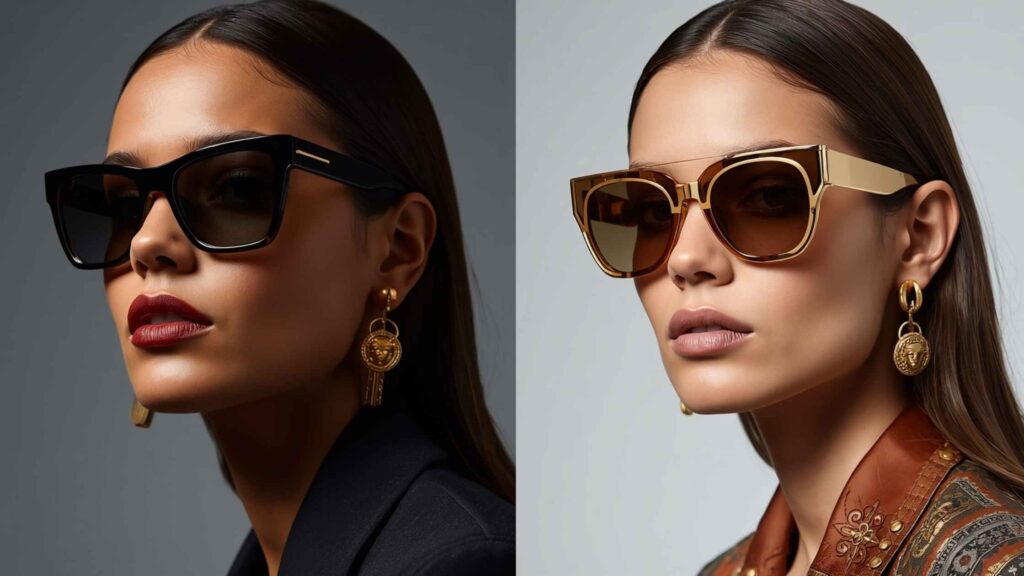
The Heritage Contrast — Two Different Routes to Bold
Every meaningful bold fashion comparison begins with understanding how each house arrived at its specific expression of boldness — because the route shapes the destination in ways that remain visible in every design decision both brands make today.
Tom Ford built his design identity from the inside of the fashion establishment — absorbing, deconstructing, and ultimately mastering the European luxury tradition before departing to build his own house on its foundations. His time at Gucci from 1994 to 2004 produced some of the most discussed and most influential fashion of the late twentieth century — collections that combined overt sensuality with precise tailoring, that made glamour feel simultaneously accessible and exclusive, and that built a visual language rooted in cinema’s most powerful imagery. When Ford launched his eponymous brand in 2005, he brought all of this accumulated intelligence to bear on a design philosophy that treats every product — eyewear included — as a piece of a larger, coherent, carefully controlled aesthetic world.
Tom Ford boldness is the boldness of complete creative authority — the confidence of someone who knows exactly what they’re doing and does it with total conviction. The frames are large where largeness serves the design. The hardware is prominent where prominence serves the brand identity. The proportions are dramatic where drama serves the wearer’s presence. Nothing is accidental, nothing is excessive in the sense of exceeding its purpose, and the overall effect is of luxury that has been edited to maximum impact.
Versace arrived at boldness from a completely different direction — from the specific cultural DNA of southern Italian excess, mythology, and the conviction that fashion’s highest calling is the celebration of life in its most abundant and most sensory form. Gianni Versace founded his house in Milan in 1978 and spent sixteen years building one of the most culturally potent design languages in fashion history — one rooted in Greek and Roman mythology, in the baroque visual tradition, in the specific pleasure of dressing as a form of theatrical self-declaration. The Medusa head. The Greek key pattern. The safety pin dress. The supermodel era that Versace helped create. These are not simply design choices — they are cultural events, and their impact on how luxury fashion thinks about boldness has been permanent.
Versace boldness is the boldness of mythological scale — the confidence of a house that draws from civilization’s most grandiose visual traditions and deploys those traditions with the pleasure of someone who genuinely believes that fashion should feel like an epic rather than a poem. The frames are gold where gold makes the mythology visible. The Medusa appears where the brand’s most powerful symbol can be accommodated. The proportions are generous where generosity serves the celebratory intention.
Design Language — Cinematic Control vs Mythological Abundance
The central design contrast between TF vs Versace frames is between control and abundance — between the precise, edited design language of someone who learned luxury from its most disciplined European practitioners, and the generous, referential design language of a house built on the conviction that abundance is itself a form of sophistication.
Tom Ford’s Cinematic Design Language
Tom Ford sunglasses are designed with the editorial intelligence of someone who thinks in terms of complete looks rather than individual pieces. Every frame exists within the larger TF aesthetic world — the cinematic glamour, the precise tailoring, the specific warmth of a design language rooted in Hollywood’s most sophisticated visual tradition. The T-bar logo at the temples is not simply a brand mark. It is a structural element that anchors the frame’s identity within the TF aesthetic world while performing the functional role of the temple connector.
The brand’s women’s collection — the dramatic cat-eyes, the oversized rectangles, the bold square constructions — carries Tom Ford’s specific understanding of feminine power: precise, controlled, and constructed with enough architectural authority to make a room aware of its presence without requiring the wearer to perform. The men’s collection — the strong geometric squares, the refined aviators, the contemporary rectangles — carries a masculine authority that references the kind of understated power that expresses itself through quality rather than decoration.
Design restraint, applied to maximum impact — this is Tom Ford’s design achievement in eyewear, and it is a more difficult accomplishment than its apparent boldness suggests.
Versace’s Mythological Design Language
Versace sunglasses draw from a design vocabulary that is simultaneously more specific and more historically vast than Tom Ford’s. The Medusa — the Greek mythological figure who appears on Versace’s most iconic hardware — is not simply a logo. It is a claim about the brand’s relationship with beauty, with power, and with the specific tradition of southern Mediterranean culture that treats the divine and the decorative as inseparable.
The Greek key pattern that appears across Versace’s design vocabulary — in the eyewear as temple detailing and frame surface treatment — references one of the oldest geometric patterns in Western visual culture, connecting contemporary luxury to the same visual tradition that decorated the temples and vessels of ancient Greece and Rome. This is not decorative borrowing. It is a genuine claim about the continuity between classical beauty standards and contemporary luxury fashion.
The brand’s color approach — the rich golds, the deep blacks against warm metal, the occasional deployment of the house’s signature baroque patterns in frame constructions — reflects the same conviction that more deliberate and more historically grounded decoration communicates a richer and more meaningful form of luxury than cleaner, less referential design achieves.
Key Frames — The Collections That Define Each House
Tom Ford’s Most Defining Eyewear
The TF0753 square construction is Tom Ford men’s eyewear at its most completely realized — a frame with enough geometric authority to carry the brand’s masculine design language without the heavier branding of the more overtly logo-forward pieces. Dark tortoiseshell or solid black acetate, clean proportions, the T-bar hardware at the temples providing the brand’s identity signal in its most architecturally integrated form.
The TF0539 butterfly represents Tom Ford women’s eyewear at its most dramatically expressive — the oversized construction, the cinematic scale, the frame proportions that create a presence on the face that photographs as powerfully as it appears in real life. For the woman whose aesthetic is consciously powerful, this frame is one of the most complete expressions of that power available at the accessible luxury price point.
The TF0646 slim metal aviator is Tom Ford’s most universally flattering construction — carrying the brand’s design authority within a silhouette so proportionally accommodating that it serves a genuinely wide range of face shapes and wardrobes without the specific demands of the more dramatically proportioned pieces.
The TF0237 — the iconic Tom Ford square with inlaid brow detailing — represents the brand’s most signature masculine construction, appearing consistently across seasons as the frame that most completely captures the TF aesthetic world in a single object.
Versace’s Most Defining Eyewear
The VE4361 Medusa logo frame is Versace’s most immediately brand-coded eyewear piece — a strong rectangular or shield construction with the Medusa emblem prominently placed at the temples, creating frames that are unmistakably, unambiguously Versace from any viewing distance. These are iconic frames in the most literal sense — built around the house’s most powerful visual symbol, deployed at full scale.
The VE2198 — the brand’s Greek key cat-eye — brings Versace’s mythological design vocabulary to its most inherently feminine silhouette. The Greek key temple detailing transforms a fashion accessory into a piece that wears its cultural reference as structural design element, creating a frame that carries more historical content than most luxury eyewear attempts.
The VE2140 oversized round in gold hardware represents Versace men’s eyewear at its most glamorously bold — a frame that makes no concession to restraint and requires none, carrying the house’s conviction that masculine luxury can be as expressively abundant as feminine luxury without compromising its essential authority.
The VE4390 rectangular construction with the brand’s signature baroque temple detail shows Versace engaging with a more contemporary silhouette while maintaining its characteristic decorative vocabulary — demonstrating that the house’s design language is flexible enough to accommodate modern proportions without losing its mythological character.
Materials — Different Investments, Same Tier
Best luxury sunglasses 2026 material assessment for Tom Ford and Versace reveals comparable overall quality at similar price points, with different material priorities reflecting each brand’s design philosophy.
Tom Ford invests most significantly in construction precision and the quality of its hardware. The T-bar components are well-finished and substantial — not costume jewelry weight but genuinely crafted metal pieces that maintain their appearance through daily wear. Acetate quality is good across the collection, with the brand’s color development producing the warm tortoiseshells and rich solids that suit its cinematic design language. Metal constructions use quality alloys with reliable plating that holds through typical daily wear conditions. The overall material standard is honest premium — justifying the price through consistent quality rather than exceptional specification.
Versace invests most significantly in hardware presence and surface decoration quality. The Medusa hardware is the most substantively crafted brand emblem in either collection — the level of detail in the Medusa face, the quality of the finish across the emblem’s surface, and the heft of the metal component all reflect genuine manufacturing investment. Gold plating across the collection is applied with the warmth and consistency that the brand’s precious aesthetic demands. Acetate quality is comparable to Tom Ford’s across similar construction types, with Versace’s color palette running warmer and more golden to suit the brand’s Mediterranean design sensibility.
Both brands occupy the $280 to $550 USD price range for their core collections — Tom Ford occasionally pushing slightly higher on more architecturally complex pieces, Versace on its most hardware-intensive Medusa constructions. Neither brand’s material quality significantly exceeds the other; the differentiation is in what the material investment is in service of rather than in the investment’s total value.
Cultural Identity — Hollywood vs Mythology
Iconic frames carry cultural identity beyond their design language — and the cultural identities that Tom Ford and Versace project are among the most distinctly different in the luxury eyewear market.
Tom Ford projects Hollywood — specifically the version of Hollywood where power, beauty, and the most controlled possible self-presentation coexist in a single, carefully managed aesthetic. The brand’s associations run through film, through the entertainment industry’s most image-conscious personalities, through the specific glamour of a luxury world that takes its visual cues from cinema’s most sophisticated creative tradition. Wearing Tom Ford communicates fashion literacy at a high level, aesthetic confidence at a specific register, and an engagement with luxury that prioritizes the precision of impact over the abundance of expression.
Versace projects mythology — the specific cultural world of southern Italian abundance, classical beauty standards, and the pleasure of dressing as an act of historical connection rather than simply of personal expression. The brand’s associations run through pop music (Jennifer Lopez’s green jungle dress remains one of fashion’s most discussed single garments), through the supermodel era that the house helped define, through the specific aesthetic of a house that has always believed fashion should feel epic. Wearing Versace communicates a different relationship with luxury — one rooted in celebration rather than control, in abundance rather than precision, in the pleasure of mythology made wearable.
These cultural identities are not simply marketing positions. They are genuine expressions of each house’s founding philosophy, and they produce real differences in how each brand’s eyewear is perceived across different cultural contexts and communities.
Men and Women — How Each Brand Serves Both
The men and women eyewear comparison between Tom Ford and Versace reveals genuinely different approaches to serving both audiences — approaches that reflect each brand’s design philosophy as much as conventional fashion market segmentation.
Tom Ford serves both genders through precision and control — masculine pieces that carry their authority through geometric exactness and restrained branding, feminine pieces that carry their authority through dramatic proportion and the specific cinematic power that the brand’s women’s design language has always prioritized. The brand’s unisex appeal derives from the consistent quality of its design intelligence applied across gender boundaries — TF frames are recognizably TF regardless of the gender they’re designed for, united by the same aesthetic conviction.
Versace serves both genders through abundance and mythological reference — with the Medusa appearing as equally powerful on masculine and feminine frames, the Greek key detailing carrying its historical weight regardless of the face wearing it, and the brand’s gold hardware performing its role as civilization-adjacent precious material for buyers of any gender who respond to that specific form of luxury signal. The brand’s unisex appeal derives from the universality of its cultural references — Greek mythology doesn’t have a gender, and neither does the pleasure of wearing something that treats fashion as an epic.
Which Is Better — TF or Versace for Your Style?
The Tom Ford vs Versace sunglasses question resolves most cleanly through a direct confrontation with the personality each brand was built for — because the aesthetic difference between them is significant enough that most buyers will feel a clear pull toward one rather than genuine uncertainty between them.
Tom Ford is the right choice if your personal style is built around controlled elegance — around the conviction that the most powerful fashion statement is the most precisely edited one, that boldness expressed through exact proportion and deliberate restraint communicates more effectively than boldness expressed through abundance and decoration. TF suits the buyer who dresses with cinematic self-awareness, who understands that a strong frame in the right proportions can carry an entire outfit’s personality without requiring the clothing to do additional work. It suits buyers in creative industries, professional contexts where image management is a conscious consideration, and social environments where fashion literacy is assumed and the precision of TF’s design language is legible to the people whose recognition matters.
Versace is the right choice if your personal style is built around celebratory abundance — around the conviction that fashion’s highest function is the fullest possible expression of sensory pleasure, historical connection, and the specific joy of dressing as a form of mythological participation. Versace suits the buyer who dresses with operatic self-awareness, who understands that a gold Medusa frame makes a claim about the scale and seriousness of their aesthetic ambitions rather than simply their brand preferences. It suits buyers who respond to pop culture’s most glamorous references, who dress for occasions as much as for contexts, and who find more satisfaction in the pleasure of abundant beauty than in the satisfaction of precise control.
The buyer who genuinely can’t choose between them may need to ask a more fundamental question: do you want your luxury to feel edited or celebrated? The answer to that question is the answer to the comparison.
Styling — How Each Brand Wears Best?
Tom Ford frames find their most natural home with wardrobes built on strong silhouettes and deliberate composition — tailored suiting in dark tones, structured outerwear, the kind of clothing that carries its own visual authority and gives the frame a suitably serious context. For women, the brand’s dramatic cat-eyes and oversized constructions work most powerfully against clean, single-color dressing that allows the frame to carry the composition’s entire expressive weight. For men, the brand’s geometric squares integrate with everything from formal suiting to quality casual, always reading as deliberately chosen rather than assembled by accident.
Versace frames find their most natural home with wardrobes built on warmth, richness, and the specific pleasure of dressing abundantly. The brand’s gold hardware and Medusa detailing want warm company — rich fabrics in deep jewel tones, quality leather accessories in cognac and warm brown, the kind of considered abundance that reads as deliberately Mediterranean in its sensory richness. The Greek key frames work particularly well with print dressing — the frame’s decorative sophistication and a richly patterned garment can coexist when both are chosen with enough aesthetic intelligence to prevent competition.

FAQ — Tom Ford vs Versace Sunglasses
Which is better for everyday wear — Tom Ford or Versace?
For everyday cross-context versatility, Tom Ford has a practical advantage — the brand’s more controlled design language integrates across professional, casual, and social environments without requiring specific wardrobe support. Versace’s more overtly branded and decoratively abundant pieces require contexts and wardrobes strong enough to match their visual energy.
Are Versace sunglasses considered high quality?
Yes — Versace sunglasses maintain genuine premium quality standards at their price point. The Medusa hardware is among the most substantially crafted brand emblems in accessible luxury eyewear. Acetate and metal construction quality is consistent and appropriate to the brand’s positioning. The quality delivers honestly on the price rather than relying purely on brand equity.
Which brand is more popular with younger luxury buyers?
Both brands maintain strong appeal with younger luxury buyers for different reasons. Versace’s pop culture associations — its music industry connections, its celebrity presence, its mythological design language — resonate strongly with younger audiences who engage with luxury through cultural rather than fashion-historical references. Tom Ford’s cinematic precision and creative-industry associations appeal to younger buyers who approach luxury through aesthetic intelligence and design connoisseurship.
Do Tom Ford or Versace sunglasses hold their value better?
Both brands maintain reasonable secondary market value. Tom Ford’s more consistent design language across seasons produces more stable secondary demand for core models. Versace’s most iconic Medusa pieces — particularly in the brand’s most recognizable gold hardware configurations — hold secondary value strongly within the brand’s specific collector community.
Which brand suits men better?
For men, the choice depends on the masculine aesthetic register preferred. Tom Ford serves the man whose masculine style is built on controlled precision — geometric frames that carry authority through exactness rather than decoration. Versace serves the man whose masculine style embraces decorative abundance — Medusa hardware and Greek key detailing for the buyer who responds to mythological scale as a legitimate masculine aesthetic.
The Epic vs The Edit
Tom Ford vs Versace sunglasses ultimately asks which relationship with boldness feels more honestly yours — the bold that comes from complete editorial control, or the bold that comes from complete celebratory commitment.
Tom Ford edits luxury down to its most precisely impactful form — removing everything that doesn’t serve the cinematic vision and trusting the remaining elements to carry the full weight of the aesthetic argument. The result is frames that feel inevitable rather than assembled, powerful rather than decorated, and sophisticated in the specific way that precision without excess achieves.
Versace celebrates luxury in its most abundant and most mythologically grounded form — adding the Medusa, the Greek key, the gold hardware, the decorative richness that connects contemporary fashion to civilization’s most grandiose visual traditions. The result is frames that feel generous rather than restrained, celebratory rather than controlled, and sophisticated in the specific way that considered abundance achieves.
Best luxury sunglasses 2026 aren’t a single object. They are the object that fits the person wearing them — and after engaging honestly with what Tom Ford and Versace each genuinely offer, that person should know with considerable clarity which house has been building their frame all along.
Know which house fits your style? Share this comparison with someone navigating the same bold luxury choice — or explore our complete breakdown of the most compelling luxury eyewear worth investing in for 2026.






 Brush
Brush Makeup Mirrors
 Body Lotions & Body Oils

 Personal Scales
 Perfume Coffrets
 Perfume Testers
 All Eyewear
 Unisex
 Optical
 Contact Lenses
 Home Fixtures
 Dining & Bar