

Latest posts
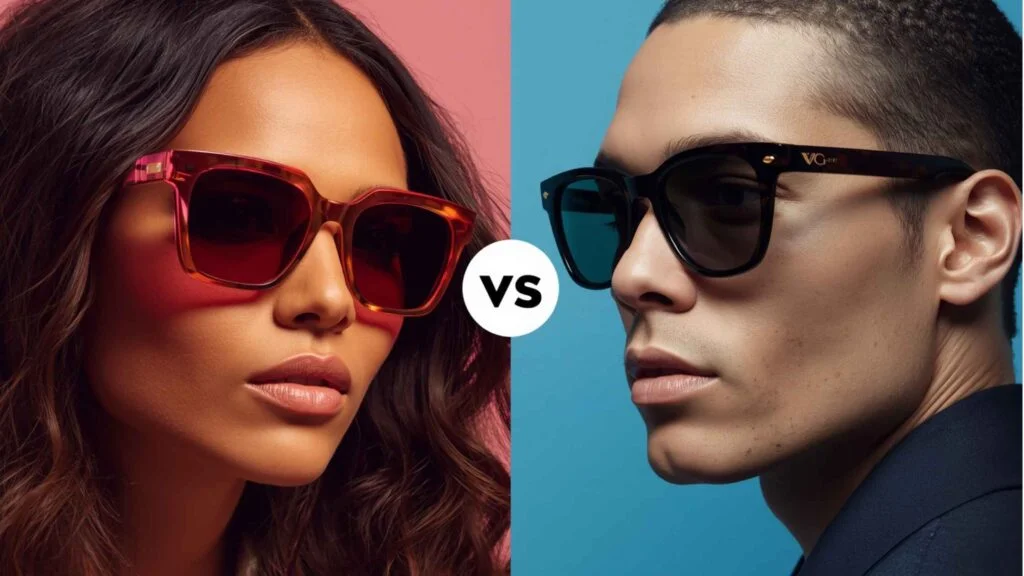
Loewe vs Gucci Sunglasses — Which Artistic Luxury Brand Fits You?

There is a particular kind of luxury conversation that goes deeper than price points and heritage credentials — deeper even than design philosophy and material quality — into the territory of genuine artistic identity. Loewe vs Gucci sunglasses is that kind of conversation. Both brands are genuinely artistic. Both produce eyewear of real creative ambition. Both have the kind of cultural authority in the current luxury market that makes choosing between them feel like a meaningful aesthetic declaration rather than simply a purchasing decision.
But they are artistic in completely different ways — ways that reflect fundamentally different answers to the question of what fashion’s relationship with art should actually be. Gucci’s artistry is celebratory — it draws from painting, from cinema, from the decorative richness of the Italian Renaissance tradition, and produces objects that overflow with visual pleasure. Loewe’s artistry is interrogative — it draws from ceramics, from sculpture, from the specific craft traditions that Jonathan Anderson has spent his creative career researching, and produces objects that ask you to think about what you’re looking at while you’re looking at it.
This luxury eyewear face-off maps both houses across every dimension that matters for the buyer who wants to understand what they’re actually choosing between — not just which frames look better, but which artistic world speaks more honestly to who they are and how they want to move through the world wearing luxury eyewear.
Table of Contents

The Artistic Foundations — Where Each House Draws Its Inspiration?
Every meaningful designer match-up between genuinely artistic luxury houses begins with understanding the creative sources each draws from — because in fashion, as in art, the inspiration is the work as much as the execution.
Gucci’s artistic world is the world of Italian cultural abundance — the Renaissance frescoes, the baroque excess, the cinematic glamour of Fellini’s Rome and Visconti’s Milan, the specific visual richness that Italian civilization has produced across five centuries of treating beauty as both a civic virtue and a personal obligation. Under Alessandro Michele’s transformative creative chapter, this world expanded to encompass literary references, art historical citations, and the kind of deeply researched cultural eclecticism that made the brand the most discussed house in fashion for nearly a decade. Current creative director Sabato De Sarno has refined rather than abandoned this heritage — the warmth, the Italian sensibility, and the design confidence remain fully intact, expressed with greater restraint but equal conviction.
Gucci’s artistic approach is fundamentally additive — it brings things together, layers references, celebrates the pleasure of cultural abundance, and produces objects that reward the viewer who knows the references while remaining visually generous to those who simply respond to the beauty. The double-G hardware, the web stripe, the equestrian codes — these are not simply brand elements. They are the visible evidence of a cultural accumulation stretching back to 1921.
Loewe’s artistic world is the world of craft as contemporary art — the ceramics, the hand-weaving, the glass-blowing, the material traditions that the Loewe Foundation has been celebrating through its craft prize since 1988, and that Jonathan Anderson has made central to the brand’s creative identity since taking the helm in 2013. Anderson’s approach draws from the history of making itself — from the specific knowledge that hands acquire through years of working with resistant materials, and from the formal problems that craft disciplines solve through iteration rather than inspiration.
Loewe’s artistic approach is fundamentally interrogative — it asks questions about form, material, and function rather than celebrating existing cultural richness. The inflated acetate frames that reference thrown pottery, the architectural constructions that reference rationalist Spanish design, the material experiments that push the boundaries of what optical manufacturing can achieve — these are not decorative references. They are genuine design research, applied to wearable objects with the same intellectual rigour that serious artists bring to gallery work.
Understanding this fundamental difference — Gucci’s celebratory accumulation versus Loewe’s interrogative research — illuminates every subsequent comparison between the brands and makes the fashion analysis of their eyewear collections considerably more useful.
Design Language — Classic Maximalism vs Sculptural Minimalism
The luxury brand differences between Gucci and Loewe are most visible in their design languages — and the contrast between Gucci’s classic maximalism and Loewe’s sculptural minimalism is the most instructive single opposition this comparison can draw.
Gucci’s Classic Maximalism
Gucci maximalism is not simply more-of-everything. It is a specific and disciplined form of abundance — the kind produced by a house that has been accumulating design codes, cultural references, and brand iconography for over a century and that deploys this accumulation with genuine creative intelligence.
The double-G hardware on a Gucci frame is not decoration applied to a generic frame. It is a design element that carries the weight of the brand’s entire history — the Florence leather goods workshop, the equestrian heritage, the Hollywood associations, the Michele-era cultural eclecticism — in a small piece of metal at the temple. The web stripe aviator carries the 1970s jet-set glamour of a brand at its most internationally expansive. The tortoiseshell cat-eye carries the mid-century Italian cinema associations that defined a specific and powerful visual culture.
This maximalism rewards brand knowledge — the more you know about Gucci’s history, the richer every frame becomes as a cultural object. But it also rewards simple visual appreciation — even without the cultural context, the frames are warm, beautiful, and generously designed. Gucci’s maximalism is welcoming rather than exclusive, celebratory rather than demanding.
Loewe’s Sculptural Minimalism
Loewe’s sculptural approach operates through subtraction and interrogation rather than addition and celebration. The inflated acetate frames carry no brand history in their form — they carry a reference to ceramic traditions, to the formal language of blown glass, to the specific visual problem of how to make a rigid material appear pneumatic. The architectural angular pieces carry a reference to Spanish rationalist design, to the geometry of buildings that prioritized structure over decoration.
This sculptural minimalism rewards design knowledge rather than brand knowledge — the more you understand about craft history, contemporary sculpture, and the formal problems that material-based art addresses, the richer each Loewe frame becomes. But unlike Gucci’s welcoming abundance, Loewe’s interrogative approach doesn’t offer the same immediate visual generosity. It asks something of you before it gives something back — and what it gives back, when you’ve met its intellectual requirement, is genuinely extraordinary.
Key Frames — The Collections That Define Each Brand
Gucci’s Defining Eyewear
GG0396S — The dramatic cat-eye that represents Gucci’s most fully expressive feminine design. Thick acetate, pronounced upswept geometry, double-G hardware at the hinge. This frame is Gucci making its fullest artistic argument about Italian feminine glamour — warm, expressive, and entirely committed to its own visual world.
GG1084S — The refined oval that represents Gucci’s most accessible and most versatile artistic expression. Slim metal construction, subtle logo integration, the kind of proportional refinement that rewards design attention without demanding it. This frame demonstrates that Gucci’s artistic intelligence operates at quiet registers as well as loud ones.
GG0009S — The web-stripe aviator that carries the brand’s equestrian heritage most directly. Heritage-coded, culturally specific, and warmly beautiful in a way that references Italian luxury history through visual shorthand that is both brand-specific and universally legible.
GG0817S — The geometric hexagonal construction that represents Gucci engaging with more architecturally ambitious design territory — the brand’s closest approach to the sculptural design language that Loewe owns most completely, executed with Gucci’s characteristic warmth rather than Loewe’s cool intellectual precision.
Loewe’s Defining Eyewear
LW40021I — The inflated frame series anchor piece. Custom acetate formulation, pneumatic volume, the brand’s most completely realized sculptural statement in eyewear form. This frame is Loewe making its fullest artistic argument — that fashion objects can be genuine sculpture, and that sculpture can be genuinely wearable.
LW40017I — The oversized round that carries the brand’s Spanish warmth within a scale that creates genuine presence without the inflated frame’s more aggressively sculptural character. More approachable than the LW40021I, equally distinctive, and demonstrating that Loewe’s artistic intelligence operates across a range of intensity levels.
LW40082I — The geometric minimal that shows Loewe’s design intelligence at its most architecturally precise — modified square geometry with the corner treatment that softens angular forms into something more organic, without losing the intellectual clarity that defines the brand’s design position.
LW40094I (Paula’s Ibiza) — The brand’s most openly joyful eyewear, demonstrating that Loewe’s artistic seriousness doesn’t preclude genuine pleasure — and that Spanish craft warmth, given enough Mediterranean light, produces objects as celebratory as anything in the Gucci catalog.
Which Is Better — Loewe or Gucci Sunglasses?
The which is better Loewe or Gucci sunglasses question resolves most usefully through a series of honest self-assessments rather than through objective quality comparison — because both brands produce genuinely excellent eyewear, and the meaningful differences between them are philosophical rather than qualitative.
Gucci is the better choice if:
You find luxury most satisfying when it celebrates — when the object you’re wearing carries cultural richness that you can feel even if you can’t always articulate it, when the brand’s history is part of what you’re wearing rather than simply the label on what you’re wearing. Gucci is better for buyers who dress with warmth and expressive confidence, who respond to Italian visual culture’s abundance as the appropriate register for luxury dressing, and who want their eyewear to be immediately beautiful as well as intellectually interesting. It’s better for buyers who want brand legibility — whose luxury should communicate across cultural and geographic contexts without requiring specialist knowledge to decode. And it’s better for buyers who find more pleasure in recognition than in discovery — who want to wear something they already love rather than something that will teach them to love it.
Loewe is the better choice if:
You find luxury most satisfying when it challenges — when the object you’re wearing asks you to think about what it is and why it looks the way it does, when the brand’s research is part of what you’re engaging with rather than simply the context for what you’re wearing. Loewe is better for buyers who dress with intellectual confidence, who respond to craft history and sculptural form as legitimate luxury values alongside aesthetic beauty, and who want their eyewear to generate genuine curiosity rather than simple recognition. It’s better for buyers who are comfortable with — who actively prefer — luxury that communicates to those who know rather than to everyone who looks. And it’s better for buyers who find more pleasure in discovery than in recognition — who want to wear something that continues to reveal itself over time rather than something that gives everything immediately.
The buyer who belongs to both is worth naming specifically — because the Gucci-and-Loewe wardrobe is perhaps the most artistically sophisticated combination available in contemporary luxury eyewear. Gucci for the contexts where cultural warmth and visual generosity are the appropriate register. Loewe for the contexts where intellectual precision and sculptural presence are what the moment calls for. The two brands don’t compete within the same artistic territory — they illuminate different dimensions of what artistic luxury can be, and a collection that includes both is a collection that has resolved the question by understanding that it was never a binary choice.
Materials — Different Investments, Different Outcomes
Brand comparison at Gucci and Loewe’s level requires honest material assessment — and both brands make genuine material investments, but in different directions that reflect their respective artistic philosophies.
Gucci’s material investment is directed toward warmth, color depth, and the decorative quality of its hardware. Acetate is sourced from premium Italian suppliers with proprietary colorway development that produces the warm tortoiseshells and rich neutrals that define the brand’s visual palette. Hardware finishing is jewelry-quality — the double-G components are substantial, well-finished, and reflect the brand’s association with Italian precious goods traditions. The overall material proposition communicates warm Italian luxury with consistency and reliability.
Loewe’s material investment is directed toward formal innovation and craft quality. The brand develops custom acetate formulations specifically for constructions like the inflated frame series — formulations that cannot be achieved with standard optical acetate and that require the manufacturing investment of bespoke material development. Surface treatments are calibrated with the precision of a ceramics studio. The brand’s Spanish craft heritage translates into a material attention that prioritizes tactile quality alongside visual quality — frames that reward touching as much as looking.
At comparable price points — both brands typically ranging from $400 to $700 USD across their core collections — the material investments are genuinely equivalent in total value while being directed toward different aesthetic ends. Neither brand is materially superior; each is materially optimized for its specific artistic philosophy.
Cultural Identity — What Each Brand Projects?
Luxury eyewear face-off analysis requires engaging with the cultural signals each brand produces — because in luxury fashion, what your accessories communicate matters alongside what they are.
Gucci projects the cultural identity of Italian fashion at its most globally legible and most historically rich. The brand is understood across every luxury market on earth, communicates warmth and aesthetic confidence to audiences with widely varying fashion literacy, and carries the specific cultural weight of a house that has shaped global fashion conversation for decades. Wearing Gucci communicates Italian luxury engagement at a level that is simultaneously sophisticated and inclusive — it doesn’t require insider knowledge to appreciate, which is both its greatest commercial strength and its most important artistic characteristic.
Loewe projects the cultural identity of the contemporary art and craft world’s most fashion-engaged participant — a brand recognized most completely by people who follow both fashion and art seriously, who understand Jonathan Anderson’s creative references, and who value the specific form of cultural authority that comes from operating at the intersection of luxury making and artistic thinking. Wearing Loewe in 2026 communicates something specific about your cultural position — that you’re engaged with fashion at the level where it becomes indistinguishable from art practice — and that communication is most legible within the communities where that distinction carries genuine weight.
Styling — How Each Brand Wears?
Gucci frames reward dressing that meets their warmth and visual richness at an equivalent level — quality fabrics in warm tones, considered accessories, the kind of Italian-adjacent luxury casual that treats getting dressed as a sensory pleasure. The brand’s maximalist pieces require clothing simple enough to give them space; the brand’s more restrained pieces accommodate richer wardrobe compositions. The consistent thread: warmth, quality, the deliberate assembly of beautiful things.
Loewe frames reward dressing that shares their intellectual precision — clean silhouettes, quality materials chosen for their specific physical properties rather than their decorative potential, and the kind of sculptural approach to outfit composition that treats proportion and form as primary values. The inflated series frames require the simplest possible clothing backgrounds; the geometric and oval pieces accommodate more varied dressing while still rewarding the same quality of compositional thought.
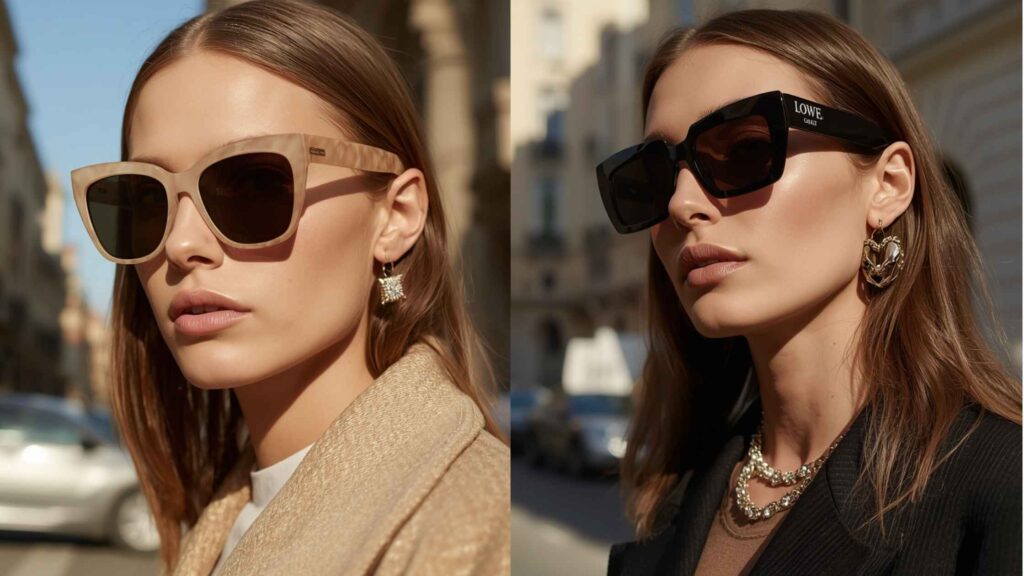
FAQ — Loewe vs Gucci Sunglasses
Which is better for everyday wear — Loewe or Gucci?
For everyday wardrobe versatility, Gucci has a practical advantage — the brand’s warm design language and broad silhouette range integrate more naturally across different daily contexts and wardrobe registers. Loewe’s more architecturally demanding pieces, particularly the inflated series, require more deliberate styling for everyday contexts. Loewe’s geometric minimal and oval pieces offer better daily versatility within the brand’s range.
Are Loewe sunglasses worth the price premium?
Loewe eyewear justifies its pricing through genuine material innovation — particularly in the custom acetate formulations required for the inflated series — authentic artistic ambition backed by the Loewe Foundation’s institutional commitment to craft, and a design originality that has no direct competitor at comparable price points. For buyers who connect with the brand’s specific artistic philosophy, the investment is fully justified.
What makes Gucci eyewear artistically significant?
Gucci’s artistic significance in eyewear derives from the brand’s deep cultural accumulation — the design codes, heritage references, and Italian craft traditions that transform each frame from a fashion accessory into a cultural artifact. The brand’s consistent ability to make that cultural richness wearable and emotionally accessible, rather than merely intellectually interesting, is its most significant artistic achievement.
Which brand suits younger luxury buyers better?
Both brands appeal strongly to younger luxury buyers for different reasons. Gucci’s cultural presence in music, film, and digital culture gives it broader appeal across age groups. Loewe’s critical standing and Jonathan Anderson’s specific cultural positioning — engaged with art, craft, and the contemporary creative conversation — resonates particularly strongly with younger buyers who approach luxury through cultural intelligence rather than heritage prestige.
How do Loewe and Gucci compare for investment value?
Both brands maintain strong secondary market positions, but for different reasons. Gucci’s broader global recognition drives consistent secondary demand across geographies. Loewe’s more limited production runs and growing critical standing among fashion insiders create strong demand within the collector market. Both represent reasonable investment value; Gucci’s returns are more geographically consistent, Loewe’s potentially stronger within fashion-forward collector communities.
Two Artists, One Canvas
Loewe vs Gucci sunglasses is ultimately a question about which artistic conversation you want your eyewear to participate in — and both conversations are worth having.
Gucci invites you into a celebration — of Italian cultural history, of the specific pleasure of beautiful objects made with warmth and craft confidence, of the luxury tradition that has been building its visual language for over a century. When you wear Gucci, you participate in that tradition, carry its warmth on your face, and communicate through one of fashion’s most universally understood artistic languages.
Loewe invites you into a research project — into the specific intellectual territory where craft traditions, contemporary sculpture, and fashion design overlap in ways that produce objects genuinely unlike anything else in the luxury market. When you wear Loewe, you participate in that research, carry its precision on your face, and communicate through one of fashion’s most creatively ambitious and most intellectually honest artistic languages.
Which is better, Loewe or Gucci? The one whose artistic conversation you want to be part of — the celebration or the research, the warmth or the precision, the cultural accumulation or the craft interrogation. Both are genuine forms of luxury artistry. Both are worth wearing. The question is only which one speaks most honestly in your specific voice.
Found your artistic brand match? Share this comparison with someone navigating the same choice — or explore our complete breakdown of the most artistically significant luxury eyewear worth investing in for 2026.









 Brush
Brush Makeup Mirrors
 Body Lotions & Body Oils

 Personal Scales
 Perfume Coffrets
 Perfume Testers
 All Eyewear
 Unisex
 Optical
 Contact Lenses
 Home Fixtures
 Dining & Bar